Showing posts with label morocco. Show all posts

Wednesday, June 29, 2016

The Storyteller


I am so excited to announce that my debut as author/illustrator, 'The Storyteller', is now out in stores! Take a look at the trailer below:


Featuring music by NYC-based Moroccan gnawa ensemble Innov Gnawa.

It's been amazing to see the great reception so far! I hope you will check it out. There will be a book launch party at Books of Wonder on Thursday, June 30 from 6-8PM, so I hope you can come down and celebrate with me! There will be book signing, original art, a window display, and light refreshments. Check out the event here:


For more information about the book, its inspiration, teaching resources, and reviews, check out the website:

The Storyteller Website

Get your copy at:
Amazon | Indiebound | Books-A-Million | Barnes & Noble | Simon & Schuster
Or better yet, at your local independent bookstore! 

Sunday, April 24, 2016

Morocco: The weaver as storyteller

I've been busily working on preparing for the release of my new book The Storyteller and have been neglecting my blog! But there are many new posts on The Storyteller website to read about the creation of the book and its art, as well as reviews, event announcements, and educational materials as the release gets closer (June 28!)

I'm so excited for everyone to finally see the book! It has been a long but rewarding process. And the book has been met with a wonderful reception so far! It has received a starred review from Kirkus Reviews and Publishers Weekly, as well as an amazingly thorough and thoughtful review from Betsy Bird at Fuse #8 over at School Library Journal. It is also a Fall 2016 Junior Library Guild selection. 

I am also very excited to announce that original artwork from The Storyteller, as well as some of these reportage drawings from Morocco and preparatory sketches, can be seen at the Brooklyn Public Library as a part of author/illustrator Pat Cummings' show "The Turn of the Page". Pat was one of my favorite teachers at Parsons, and is having a well-deserved residency at the Library. She has invited some of her former students who work in children's books to exhibit with her, and I am so honored to be included! I hope you'll come by and check it out! Opening reception the evening of May 9.

The post below is from The Storyteller website and features drawings from a research trip I took for the book in the fall of 2014. 


 ---
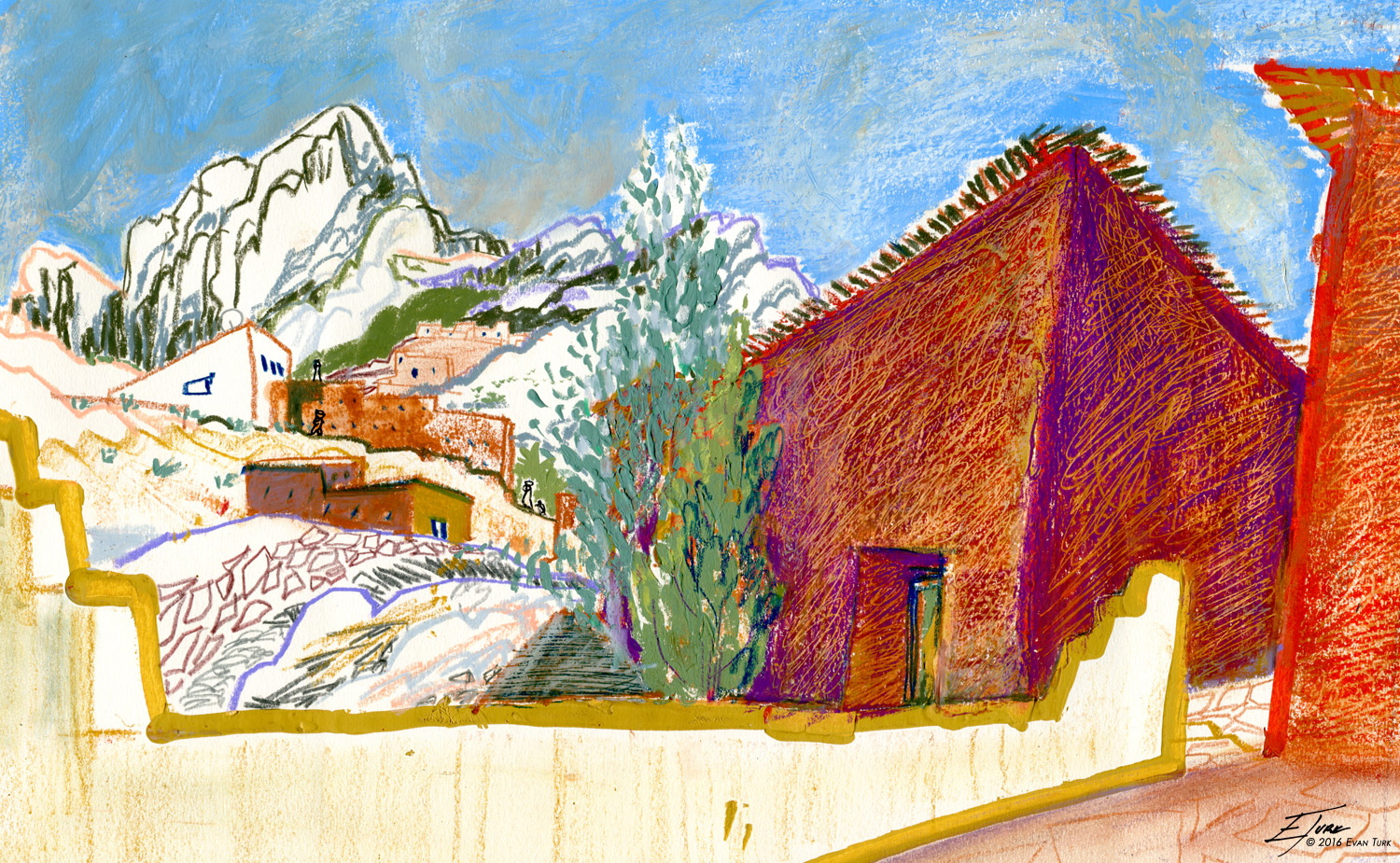
In October 2014 I took a trip to Morocco to do research for The Storyteller. One of my favorite experiences was spending a day in the village of Anzal in southern Morocco and meeting the women carpet weavers there and their family. These drawings (aside from the illustrations from the book at the end) were done on-location in Anzal and the nearby Oasis de Fint.
weaver15

I arrived at the village of Anzal and met, Naoual, a twenty two year old woman from the village who translated for me and told me about her village and the weaving association. The village is nestled in a valley between harsh, dry mountains. The landscape is both empty and calming. The ground and sky seem to extend in all directions for eternity. It is said that the top crossbar of a loom is often called “the beam of heaven” and the bottom bar, “the earth”, with everything between as “creation.”
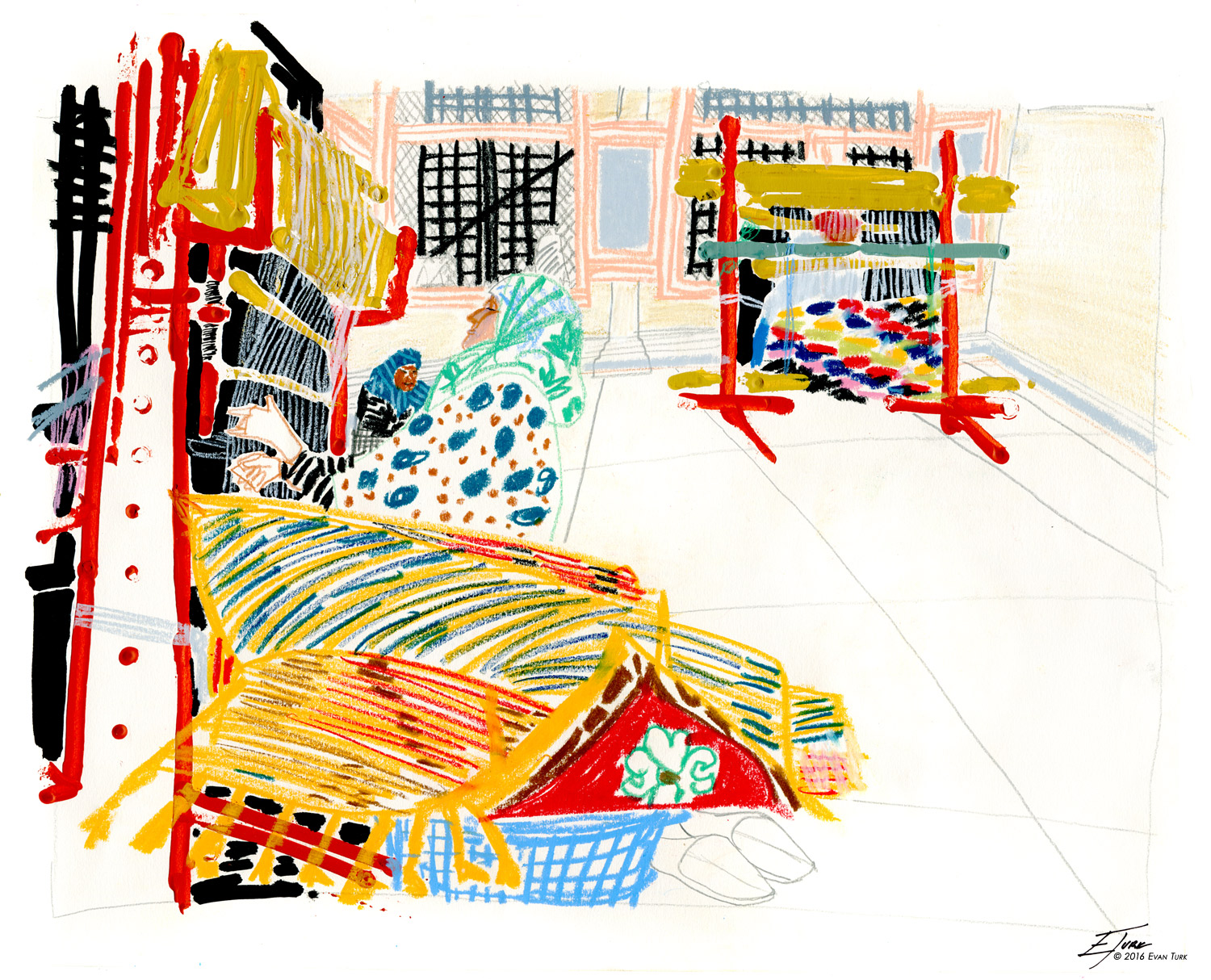
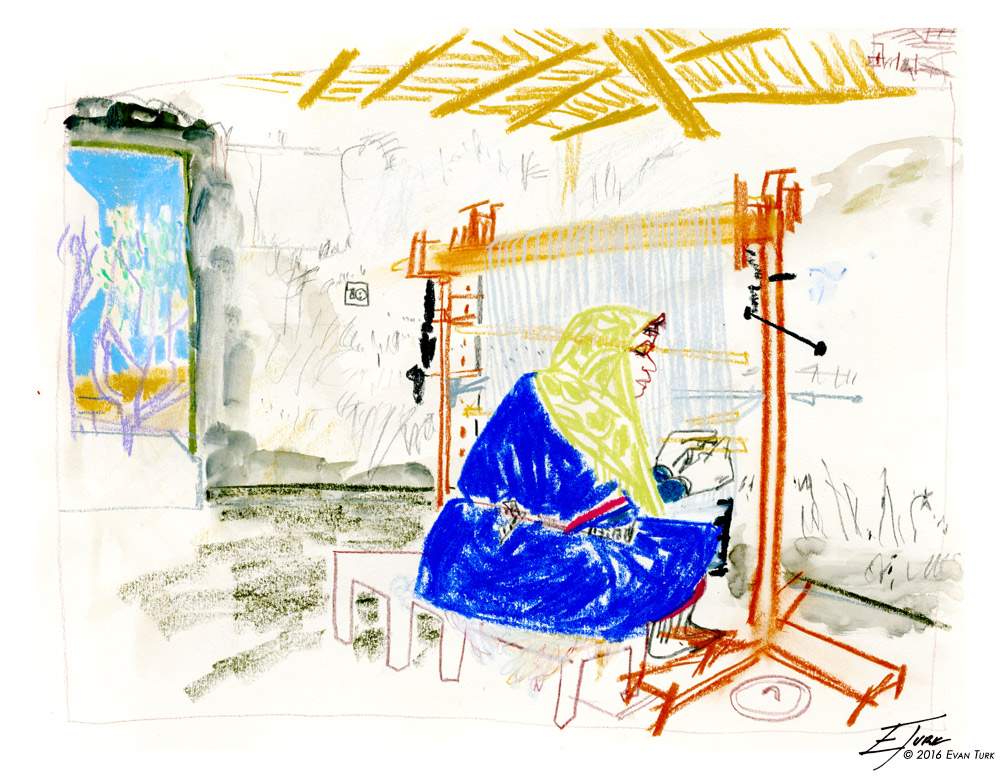
Naoual led me the short distance to the Association where I met Aicha, Fatima, and Rahma, Naoual’s mother-in-law. Aicha and Rahma were seated in front of their looms, made out of red steel I-beams and heavy wooden crossbars. A net of vertical yarns, the warp, stretched between the two crossbars in front of each weaver. Beside them were bags and cans of brightly colored, short pieces of yarn that would be knotted individually around each of the warp threads into a colorful design, the weft.

weaver06

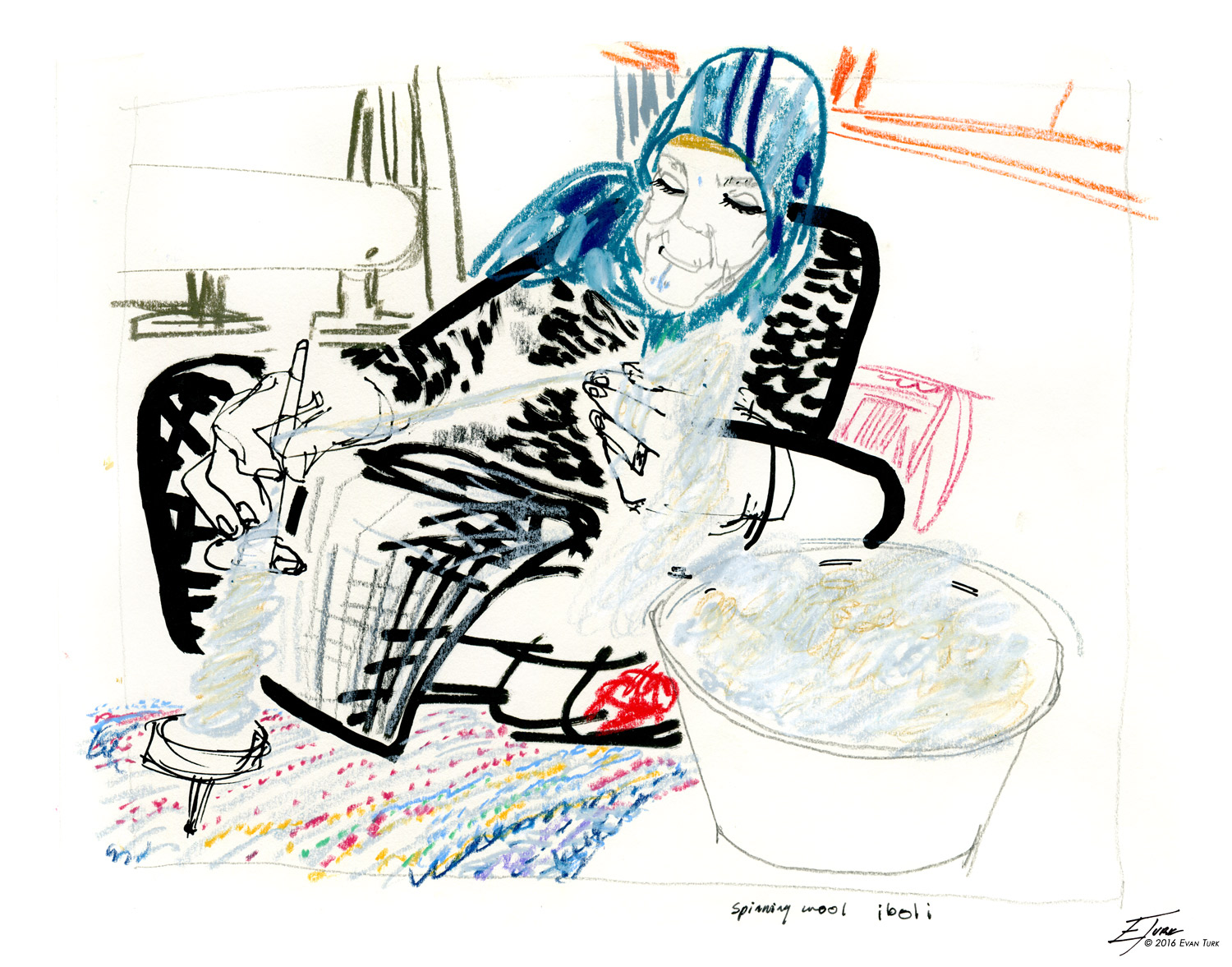
Fatima sat nearby Aicha, taking tufts of wool and winding them into yarn on a spindle, whirring between her fingers.

weaver07

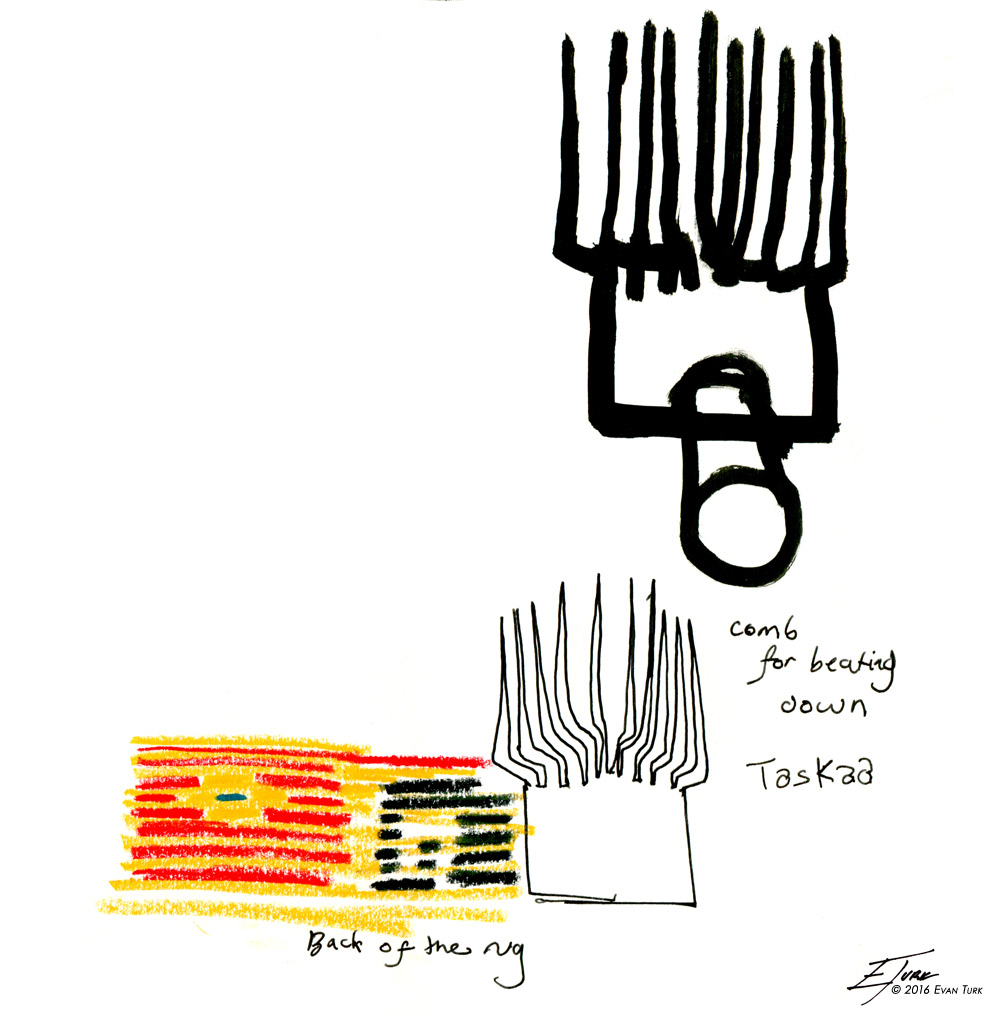
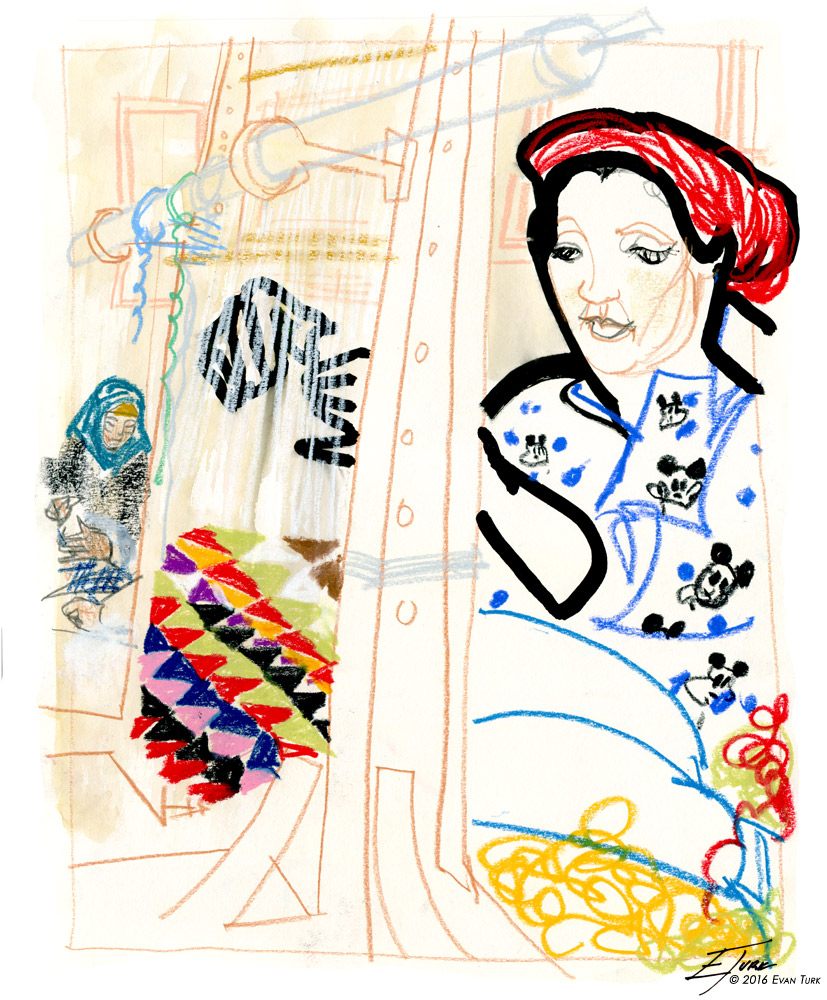
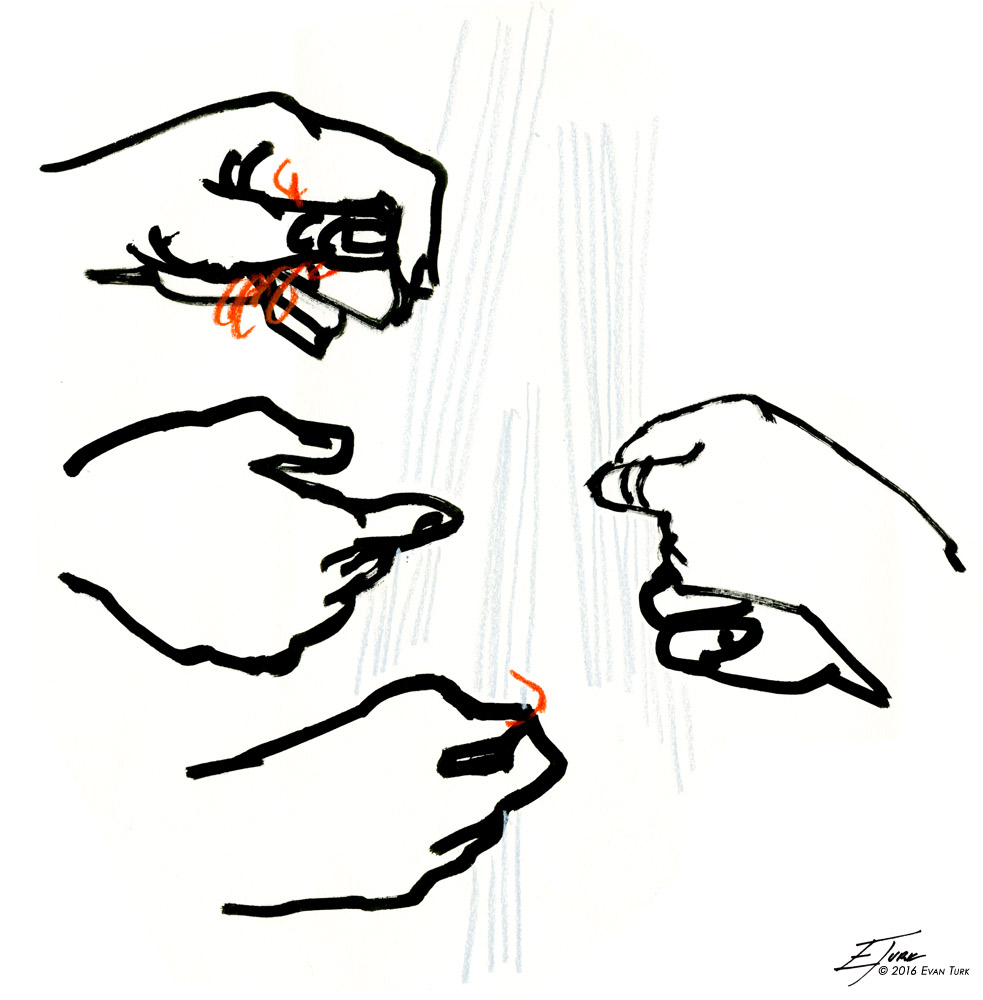
Aicha’s hands worked quickly, knotting each row, and then smacking the knots down with a comb called a taskaa, which resembled a big spider.

weaver09

Spiders are often associated with weavers, and their magical creative ability in forming webs. The act of weaving feels both magical and utilitarian. When you see a finished carpet, the staggering amount of work is both hidden behind the beauty, but also evident in each individual knot.
Patterns spread across the warp, slowly appearing as the weaver moves from side to side, row to row. Symbols, triangles, diamonds, zig-zags, and other shapes emerge. The symbols are infused with historic meaning, but also with the individual whims of the weavers.

weaver13

I watched as Rahma struggled in contemplation in the early stages of her weaving, trying to decide on a color and a direction. The dreaded “blank page syndrome” that plagues all artists at some point, manifests in the even more daunting “blank loom” which will be the home for her hands for the next many hours and days.

weaver17

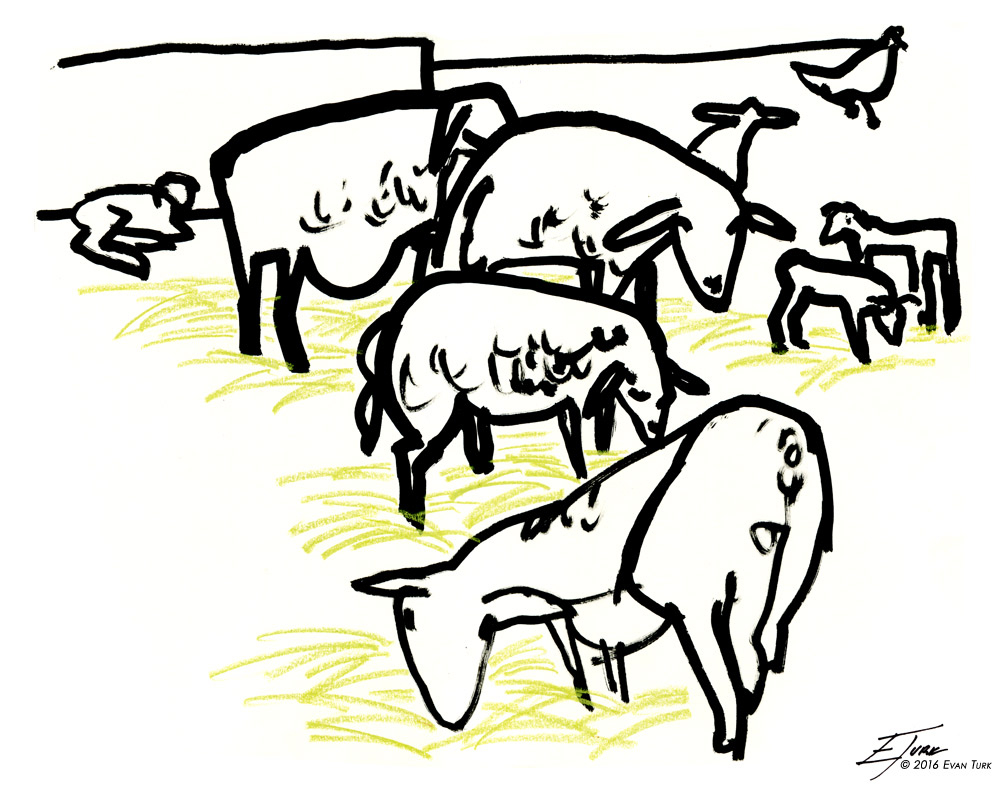
Naoual showed me her family's sheep pen (who's wool is taken for the carpets), and led me to her own house for tea and lunch with her mother-in-law, Rahma, and Fatima, the spinner. I listened as they all spoke back in forth in Tamazigh, as Naoual tried to keep me up to speed on the conversation. We discussed the growing presence of Tamazigh people in the national conversation, as it became an official language in Morocco, in addition to Arabic. Over 80% of the population of Morocco has Tamazigh ancestry, but their language was not recognized until recently. New possibilities are growing as the diversity of the country is embraced.
weaver16

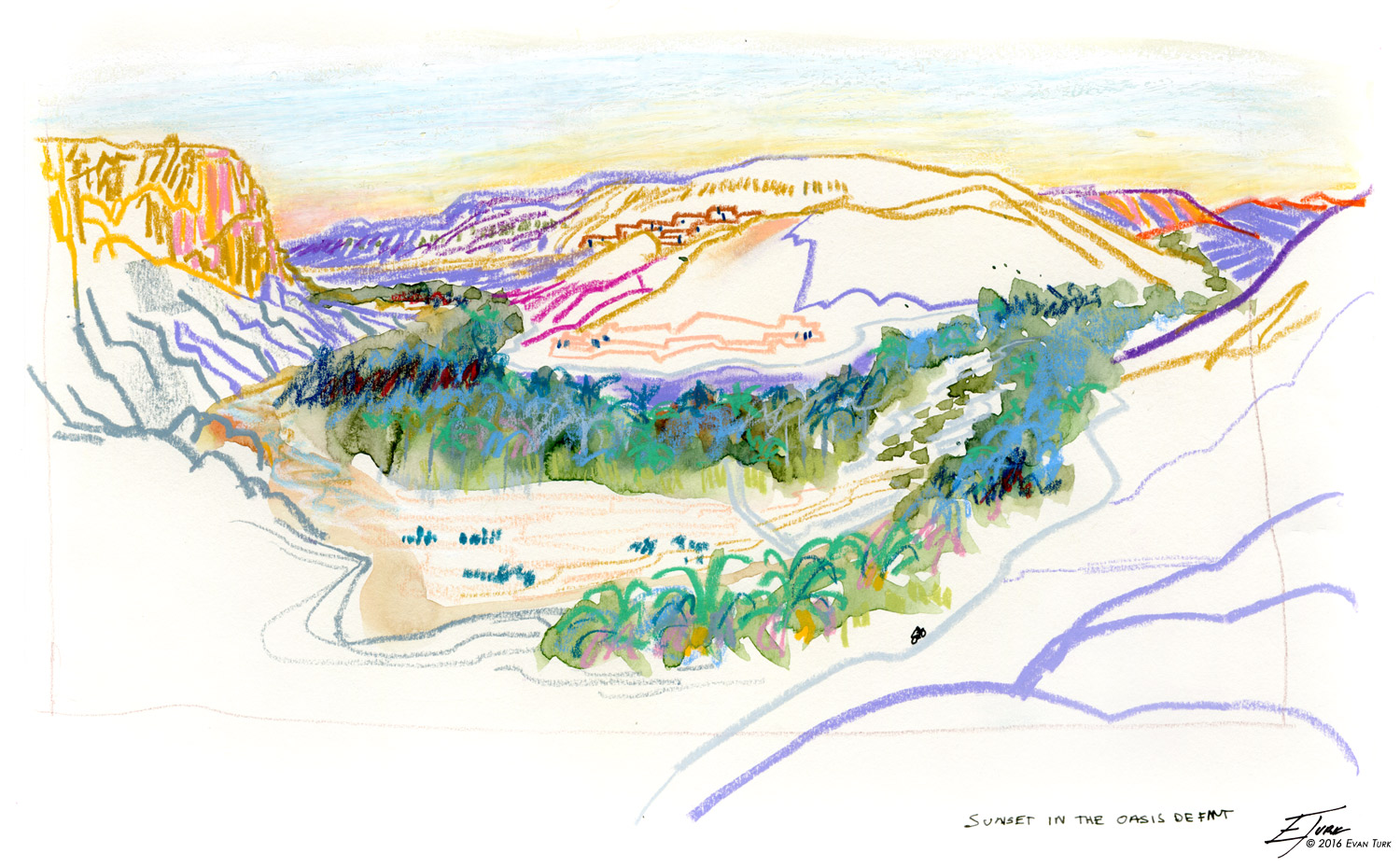
Naoual and her friend then took me on a small tour of the gardens behind the town. She showed me the water source, where Anzal’s water is filtered in from a nearby spring. The water descends from the spring into two divergent paths, towards the reservoir, or off towards the village. Trees line the cement channel made for the water. Twinkling olive trees baked in the sunlight, and shriveled pomegranates littered the ground with their seeds. The gentle breeze flowed through the valley, as if it had come from far off mountains, and the eternity of ground and sky. We talked about our lives, the differences and similarities, hopes and possibilities. As the sun began to set, we made our way back to the Association.

weaver08


We left the open valley and returned to the unadorned room with the weavers.

weaver11

A new weaver, Fatima, joined them with her carpet stretched on the loom. Undulating mountainous forms (or are they clouds?) overlap and emerge as she worked. The pattern grows, creating both ground and sky within the confines of her warp, but extending in all directions into infinity.

Sketch © Evan Turk

We then went to her mother’s house where I met her mother, brother, and sisters as we ate bread, honey, almonds, and ground dates, and laughed while sipping our hundredth cup of delicious mint tea.

weaver14

She took me to her aunt’s house where her cousins, aunt, and grandmother were doing household chores and weaving.

weaver12

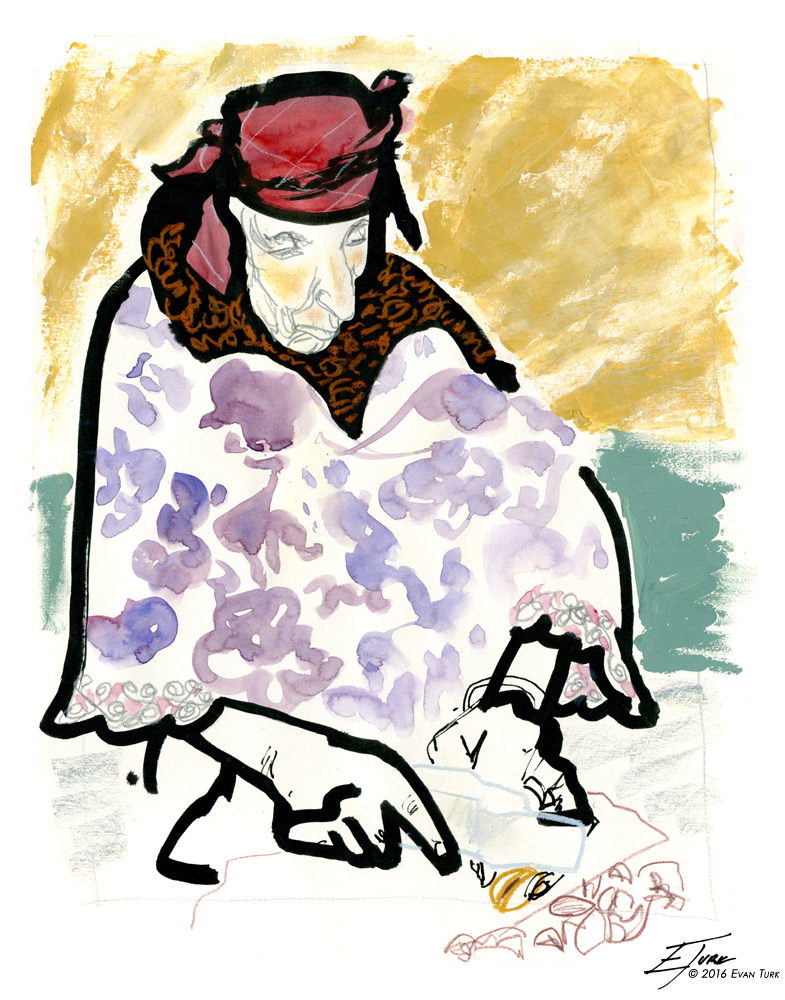
Her grandmother, with high, bronze cheeks and a warm smile, cracked almonds from their trees out of their shells with a stone in the back. She laughed as she saw her portrait, saying she couldn’t wait to tell her son that today she met a man from America who said she looked like his own grandmother.

weaver04

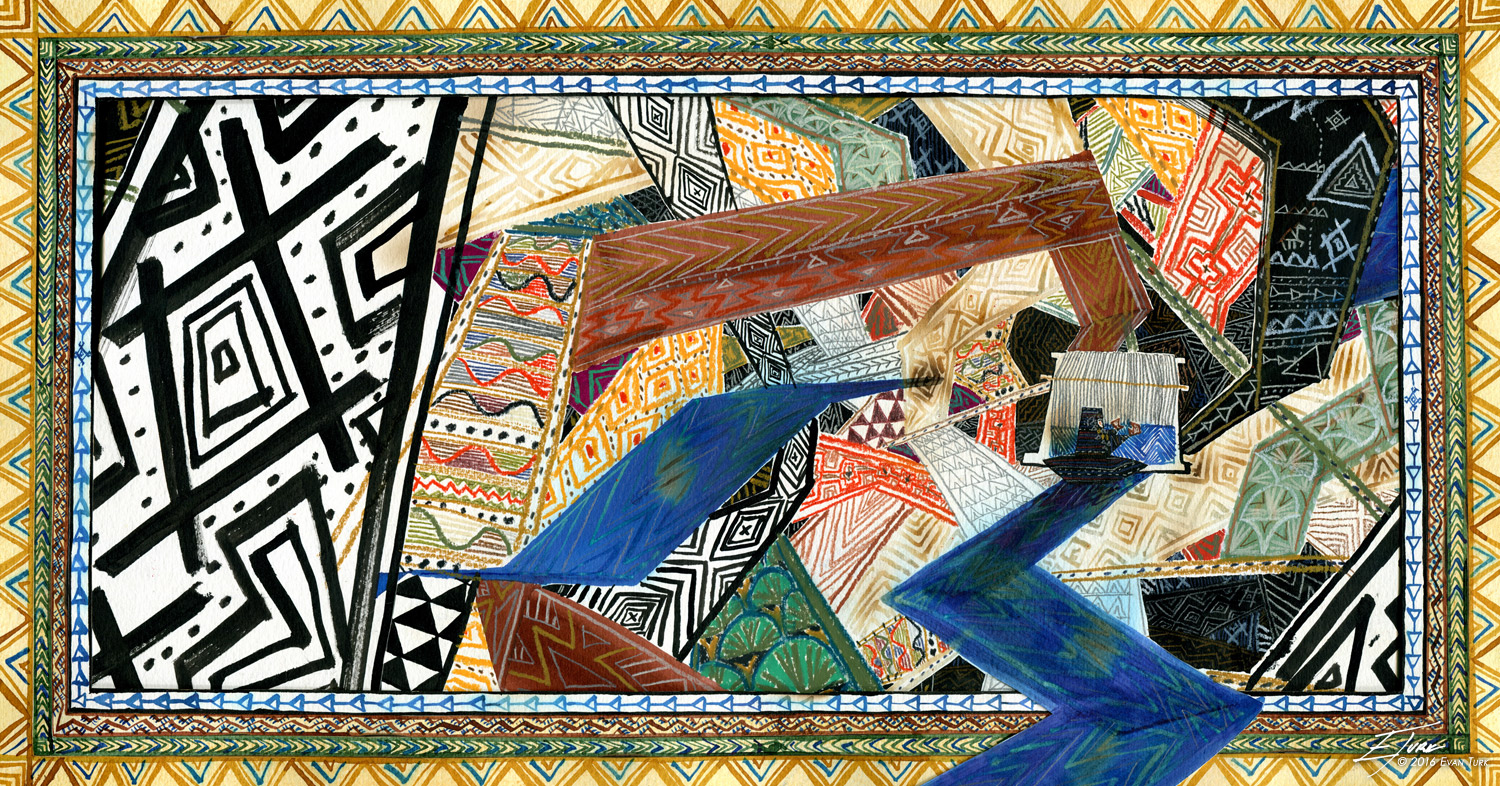
The act of weaving is often related to that of speech, or storytelling. A tale is referred to as a “good yarn” and stories are “woven” in twists and turns. The words "text" and "textile" even come from the same Latin root, texare, which means "weaving." The looms serve as repositories for words and thoughts not necessarily spoken. Patterns and symbols come together across the landscapes of the carpets, often with stories of pregnancies, births, deaths, and weddings. Like scrapbooks, created over months, the knots are woven in time as life events unfold. Older carpets seem to have been formed organically, with no plan in mind. There is just the warp to hold it together, and life to fill in the spaces as it comes.

weaver01

In the ebb and flow,
In warp and weft,
Cradle and grave,
An eternal sea,
A changing patchwork,
A glowing life,
At the whirring loom of Time I weave
The living clothes of the deity.

Goethe, Faust

For more of Evan Turk's travel illustration, check out the link below: 
Evan Turk Travel Illustration

Wednesday, July 22, 2015

Summer!


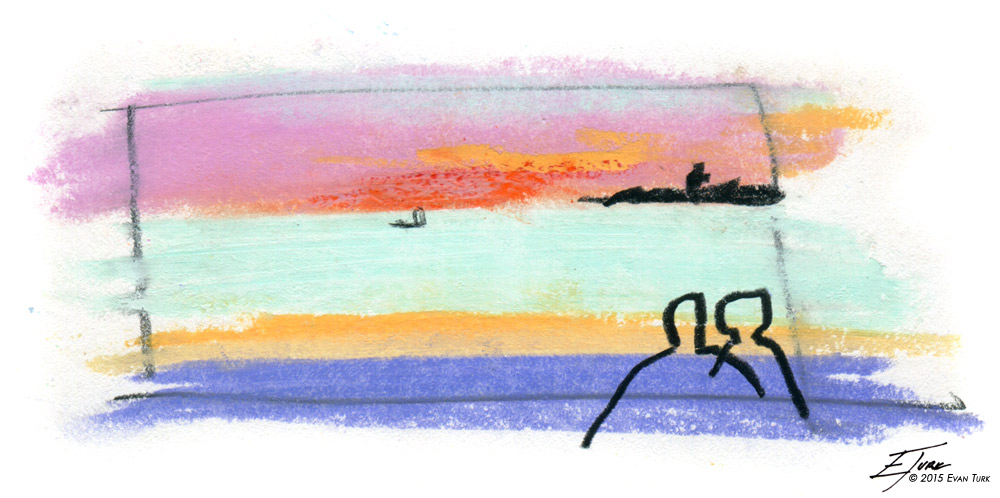
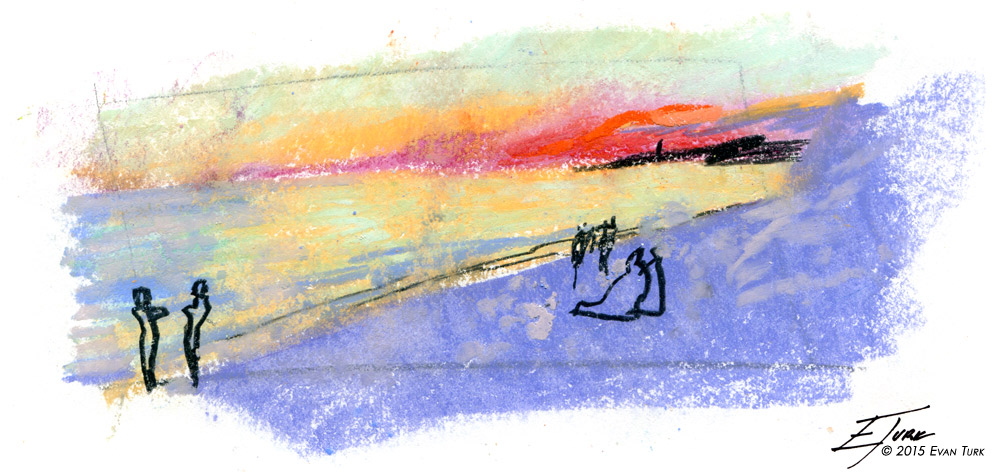
It's been a while since my last post, but there have been many wonderful exciting things happening! First, at the end of June, I got married! It was amazing and surreal, and feels like a beautiful dream already. In between the relaxing on our honeymoon in Provincetown, I did a few thumbnails of a sunset that was too amazing not to draw.


In less romantic but still exciting news, my reportage of Jerusalem was a part of an international exhibition of reportage illustration for the Reportager Award at the University of the West of England. So wonderful to be included and to see reportage work being appreciated!


I am also very honored to be representing Dalvero Academy and Canson on one of a new plein air drawing pads, all featuring Dalvero Artists! So exciting! My drawing is on the Illustration pad, with the beautiful work of Margaret Hurst on Canva Paper, Julia Sverchuk on Mixed Media, and Veronica Lawlor on watercolor. So exciting! Go check them out!


 There's also a blurb about Dalvero Academy on the inside cover!


And finally, in a sneak preview, I just received the first round of printed proofs from my upcoming book The Storyteller!


Can't wait to share the whole book with everyone! Many exciting things to come!

Thursday, September 18, 2014

People of Marrakech


I just returned from a trip to Morocco where I was exploring, drawing, and researching for an upcoming children's book about Morocco. I met amazing people, saw amazing things, and left feeling bewildered and inspired. Most of the work I did there, I will be posting closer to the release of the book (2016!) but I couldn't resist posting a few snapshots of people in Marrakech.


For more of Evan Turk's travel illustration, check out the link below: 

Monday, May 12, 2014

Writing Process Blog Tour

Thumbnail drawing from The Storyteller

I was asked to be a part of the Writing Process Blog tour by my new booking agent, at The Booking Biz, who is an author herself, Carmen Oliver. You can read her post HERE. It's sort of a blog chain letter that asks authors to explain a little bit about their how they write.

I'll be answering four questions about my writing process, which was a fun prompt for me, since this blog is mostly about my illustration and animation. But I love creating stories, whatever the medium.  I'm in the process of creating my first children's book as author and illustrator, so this seemed like a great kickoff.

What am I currently working on?

Thumbnail drawing from The Storyteller
As I mentioned above, I am in the process of writing and illustrating my first solo children's book tentatively called The Storyteller. While reading in preparation for a 3 week trip to Morocco a couple of years ago, I learned about Morocco's rich storytelling history. In a nearly one thousand year old tradition, public storytellers gather a growing audience reciting all the tales from 1001 Nights, hundreds of Moroccan folktales, and stories from the Qur'an, all from memory, and weaving the tales together to impart lessons and entertainment to their audience. This tradition, though, is in danger as less than a dozen storytellers remain in Morocco, often with no apprentices. Inspired by this, I began writing a story in which a young boy unknowingly becomes an apprentice to a storyteller and uses those stories to inspire hope and community to rescue his city from a looming sandstorm.


I am also currently working on an animation and illustration project in conjunction with Dalvero Academy, at Mystic Seaport. I am documenting the restoration of the Charles W. Morgan, the last wooden whaleship in the world, which was built in 1841. This summer, I was one of 79 voyagers selected to sail aboard its 38th voyage, and first sail since 1921. My animation, although still in the early stages, deals with the emotional and cultural impact of whaling on whale and human populations today, and how we can strive to live and grow from that history and use it as the catalyst for healing and a new attitude towards whales and nature. It is a follow up project to my award-winning animation "Patterns" about the global cultural history created by the industry of whaling.


How does my work differ from others of its genre?

I think that my work differs from other children's literature because I have a very serious interest in culture and history, but a very loud, playful, and experimental approach when it comes to art and illustration. I often find that with children's books, more serious or historic topics are often dealt with
in a very somber way, and I like to think that I have a fresh, exciting, and diverse approach to a range of topics from serious to silly. But I am still very new to the children's book industry, so I guess it remains to be seen what will set me apart!

Why do I write what I write?

I write what I write usually because some piece of information, or art, or a story will interest me and I can't help but want to learn more about it and tell that story to others. It is always amazing to me when working on a project how so many different elements all seem to fall into place in one story, and I can discover new ways to tell stories and explore topics. Often I just get excited by the idea of creating art around the idea of a story, and the rest of the pieces come together in the words. I have an interest in folk tales, culture, and art from around the world, and I think there is an immense amount that we can learn from relating to, learning from, and telling stories about traditions and stories that have stood the test of time.

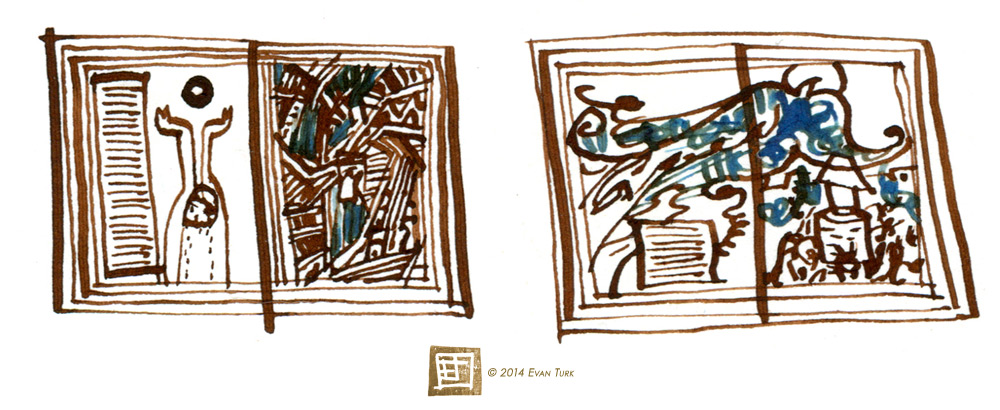
Thumbnail layouts from The Storyteller

How does my individual writing process work?

I usually will begin in an aimless research phase, where I go to museums and draw, travel, or read books and make thumbnails, and just go wherever my interest leads me. Usually, a thread will pop out somewhere along the line that will excite me to learn more, or make more drawings. As a story begins to form in my mind, I usually write it in a shorthand way, just figuring out the layout of the story itself, while making notes, thumbnails, and exploring the art along the way. This is always the most exciting step, when there are infinite possibilities for the art, and I have to sift through them to figure out how best to tell the story. When the story begins to get fleshed out, I will work on creating the page layouts in a series of of thumbnails and working on the actual manuscript for the story. Sometimes, though, the project will turn towards an animation, rather than a book, and I'll have to change gears (or vice-versa). It is all about getting the story across in the best way possible.


Next week, author Tim Anderson will join the Writing Process Blog Tour. I just finished his new book Sweet Tooth, and it was hilarious! I highly recommend it.

Tim Anderson is the author of Sweet Tooth and Tune in Tokyo: The Gaijin Diaries, which Publishers Weekly called "laugh-out-loud funny," Shelf Awareness called "so much fun," and Michiko Kakutani of the New York Times completely ignored. He is an editor and lives in Brooklyn with his husband, Jimmy; his cat, Stella; and his yoga balance ball, Sheila. Tim also writes young adult historical fiction under the name T. Neill Anderson and blogs at seetimblog.blogspot.com. His favorite Little Debbie snack cake is the Fudge Round.

Saturday, March 16, 2013

Morocco: Return to Fes


After the Sahara, we returned to Fes for a couple days and then headed back to New York. Morocco is an amazing place, but not always an easy one. It's exhausting and magical at the same time.

There aren't a lot of places in the world where you can make a drawing like the one above: There is a man riding side-saddle on a mule, who is stepping daintily over the cobblestones of a precariously narrow medieval street perched on a steep hillside, while a man in the distance twirls silk into thread down the long winding streets, as the sun begins to set, turning the whole street to gold.

I certainly can't wait to go back.

Thursday, March 7, 2013

Morocco: The Desert


Our final excursion out of Fes was to the Sahara near the border with Algeria. From Fes, it was a 9 hour drive to the dunes through some of the most amazing landscapes I've ever seen. We passed through Mediterranean rolling hills, an Atlas cedar forest, a French ski village, a whirling dust storm, one of the world's largest oases, and a high desert plateau surrounded by soaring peaks that were about to receive their first snow of the year.

We arrived at our hotel after a long drive across a desolate black plateau in the middle of a sand storm. We could barely see 5 feet on either side of the car, and even then it was only parched black earth. Our hosts came out to help us scramble inside as the blowing sand proceeded to wedge itself into every mouth, eye, ear, and otherwise.


After a tasty meal, our hosts treated us to some Berber drumming and we turned in for the night as the sandstorm blew on.

We awoke to a serene breeze through the window, and the wall of blowing black sand outside had settled to reveal endless golden dunes only 20 feet away. We ate a quick breakfast and went out to start our journey.


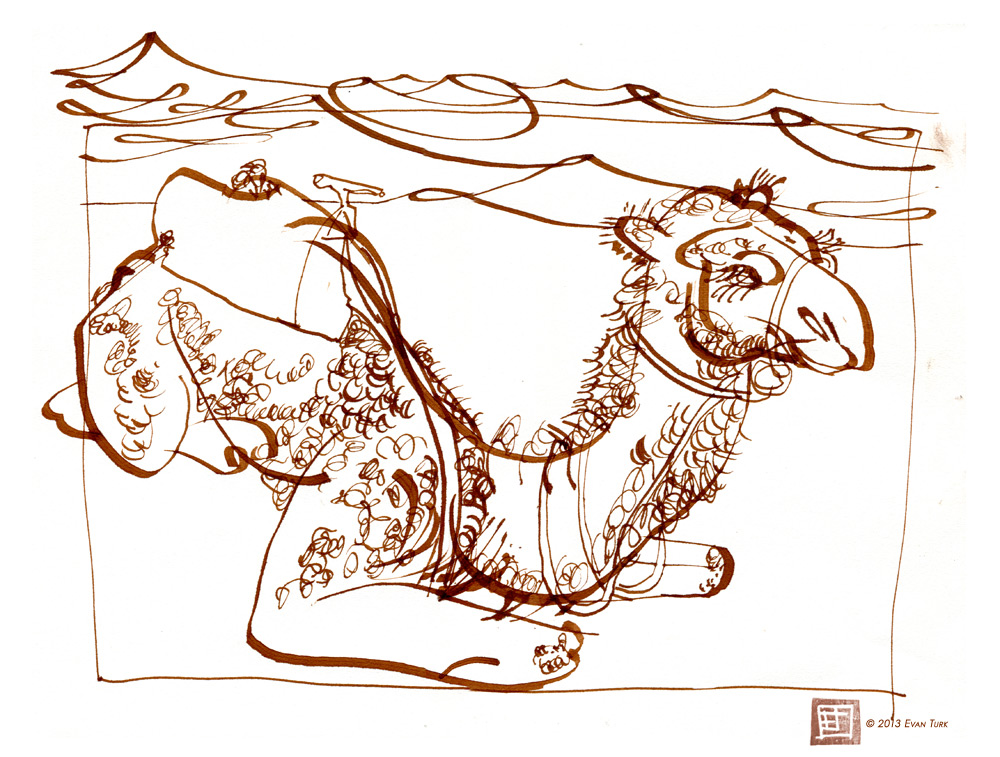
We met our two camels, one brown was brown and wooly and the other beige with a nose ring. Of course we named them after our brown and beige cats at home, Bert and Pica (We eagerly asked the camel drivers if they already had names, he answered "No. They are camels.").

The back view of Chris on the camel in front of me.

 After a long, beautiful camel ride through the martian landscape (through which the blustering wind and camel jostling made drawing close to impossible), we settled into our Berber campsite for the night, hoping to see the amazing starry skies you can only see when you're miles from civilization.

Pica the camel.

Naturally, as the sun was going down, the storm clouds were rolling in. As we were lying in our tent, trying to sleep through the booming thunder, we began to feel the pitter-patter of rain drops on our faces. The carpet/bamboo roof of our tent was not exactly waterproof, and as the frequency of the drops began to increase, we scrambled our things together and ran into the main tent where we huddled with a nice Australian family under the more substantial roof. We were treated to a torrential downpour in the middle of the Sahara desert as the deluge of water poured into the tent on all sides of our little mattresses in the center.


We didn't end up seeing any stars at all, but I feel like a rainstorm in the Sahara is just as unique of an experience, and we can see the stars the next time. Plus the sunrise the next morning made all the rain worth it, as the dunes that had been faded and shifting yesterday became crisp, solid, and vibrant after the rain.


Saturday, February 9, 2013

Morocco: The Iron Worker


When we returned to Fes, Chris and I went out into the souks and happened upon a tiny, unusual shop on one of the many alleys of craftsmen. The man, dressed in black and grey with salt & pepper hair, was making black iron work with silver wire hammered into intricate designs. The iron-worker was such a sweet man, and a real artist. We found out later that the technique is one called Damasquine, and is a Moroccan version of a Syrian craft that originally used gold wire in much more formal Islamic designs. This man, while he created the more formal Moroccan style work as well, had walls of beautiful and whimsical animals that he had drawn himself. They felt like little Picasso drawings made out of iron and silver.

After picking out all of our Christmas gifts for the year, we asked if we could stay and draw him while he worked. We were able to see him create one animal from, from start to finish, in his tiny 5x5 shop.


He began by sawing the iron into the shape of a fish.


He then scored the iron and polished it with a jade-tipped utensil.


Then he heated the iron in a burner and it came out hot and jet black.


Then, using a tiny hammer, he hammered the silver wire into a design, like drawing.

 Once he finished, he polished it again with the jade, and gave it to us as a gift. It was so wonderful to see someone so passionate about what he was doing. His father had done Damasquine in gold, and he was the 5th generation of Damasquine workers in his family. He is the only one to practice the craft in Fes (although a dozen or so others do in the nearby city of Meknes), and he said that while his children enjoy drawing, they didn't like the hard manual labor that goes with creating the iron work, so he may be the last.