Saturday, February 9, 2013

Morocco: The Iron Worker


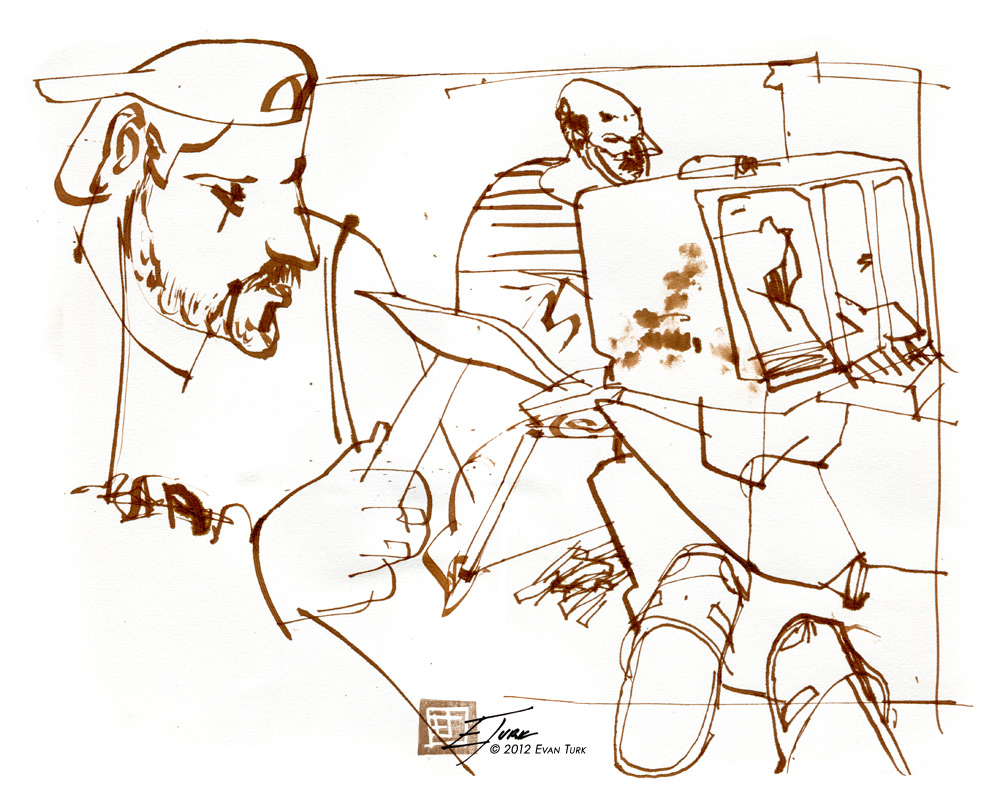
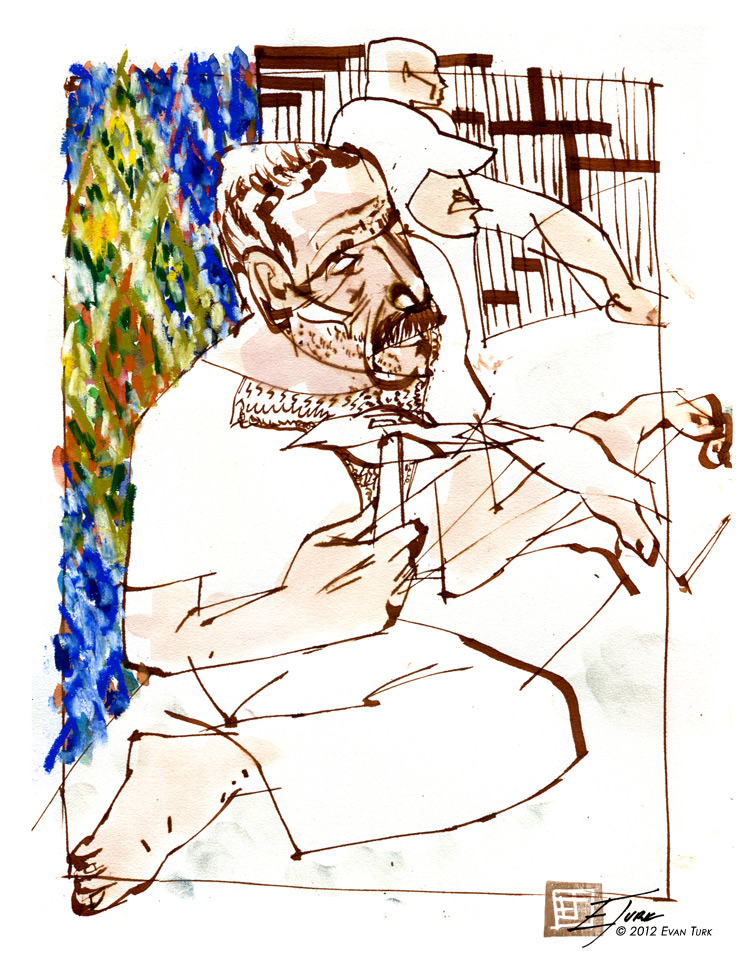
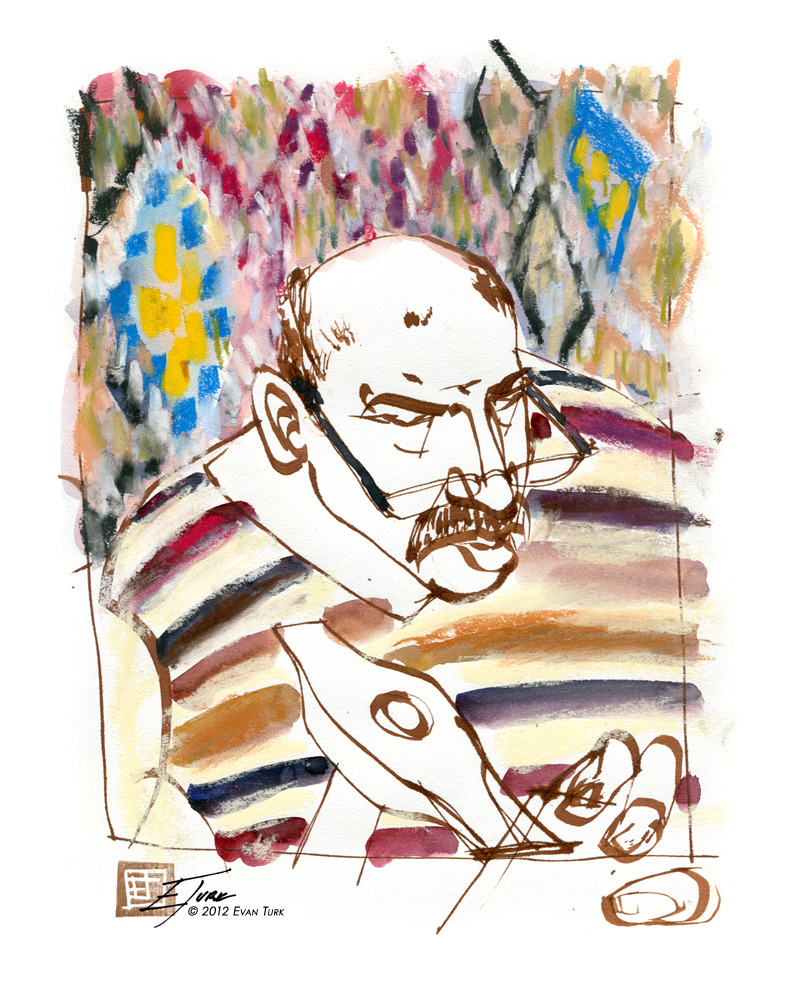
When we returned to Fes, Chris and I went out into the souks and happened upon a tiny, unusual shop on one of the many alleys of craftsmen. The man, dressed in black and grey with salt & pepper hair, was making black iron work with silver wire hammered into intricate designs. The iron-worker was such a sweet man, and a real artist. We found out later that the technique is one called Damasquine, and is a Moroccan version of a Syrian craft that originally used gold wire in much more formal Islamic designs. This man, while he created the more formal Moroccan style work as well, had walls of beautiful and whimsical animals that he had drawn himself. They felt like little Picasso drawings made out of iron and silver.

After picking out all of our Christmas gifts for the year, we asked if we could stay and draw him while he worked. We were able to see him create one animal from, from start to finish, in his tiny 5x5 shop.


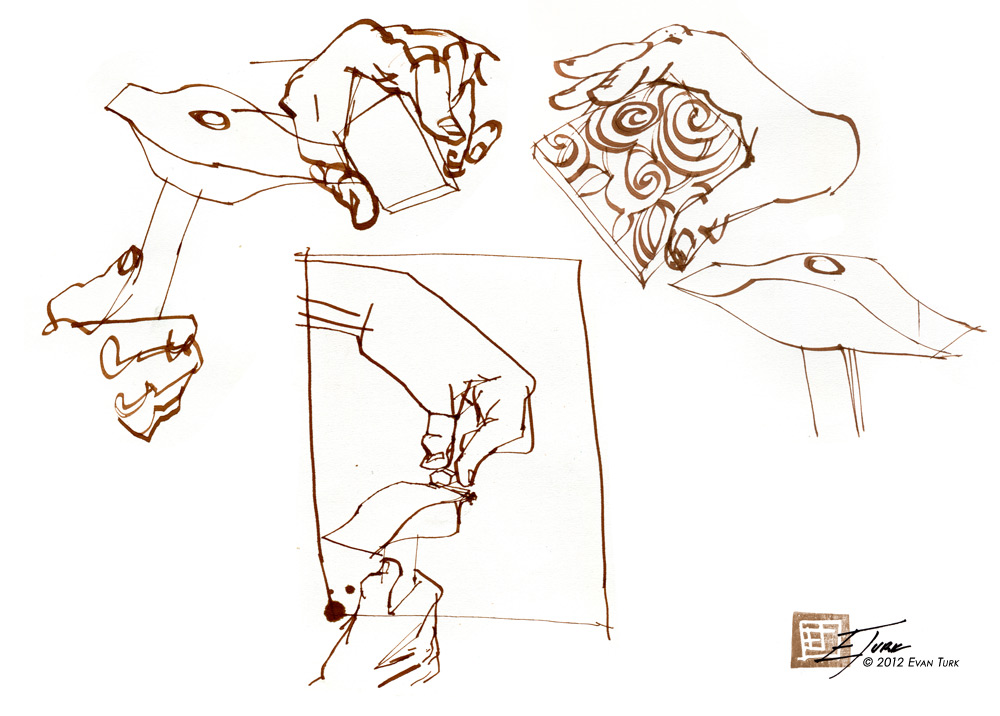
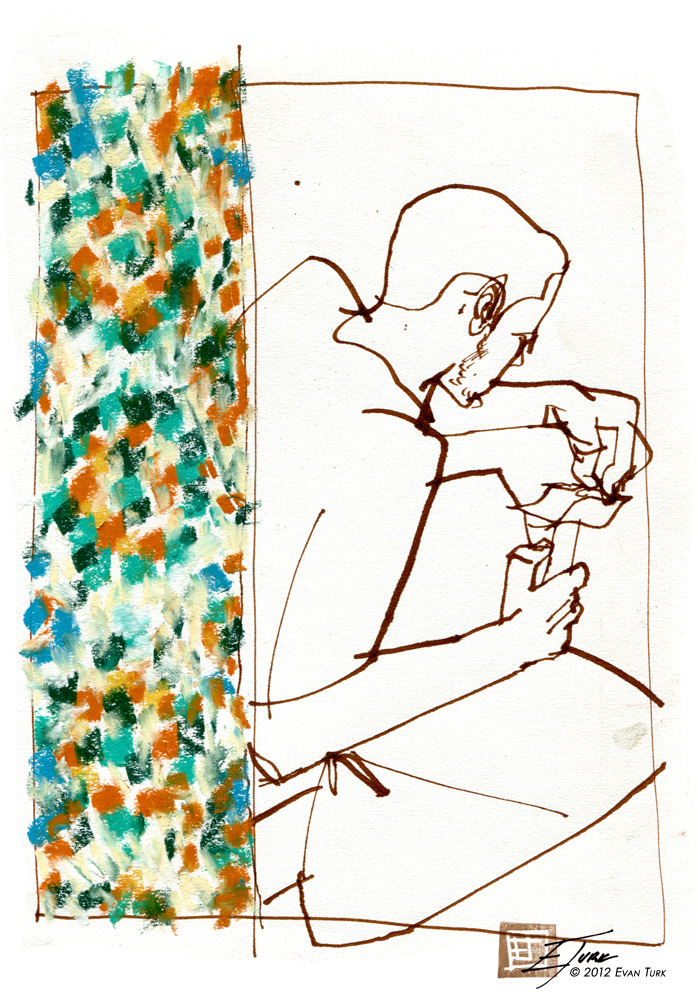
He began by sawing the iron into the shape of a fish.


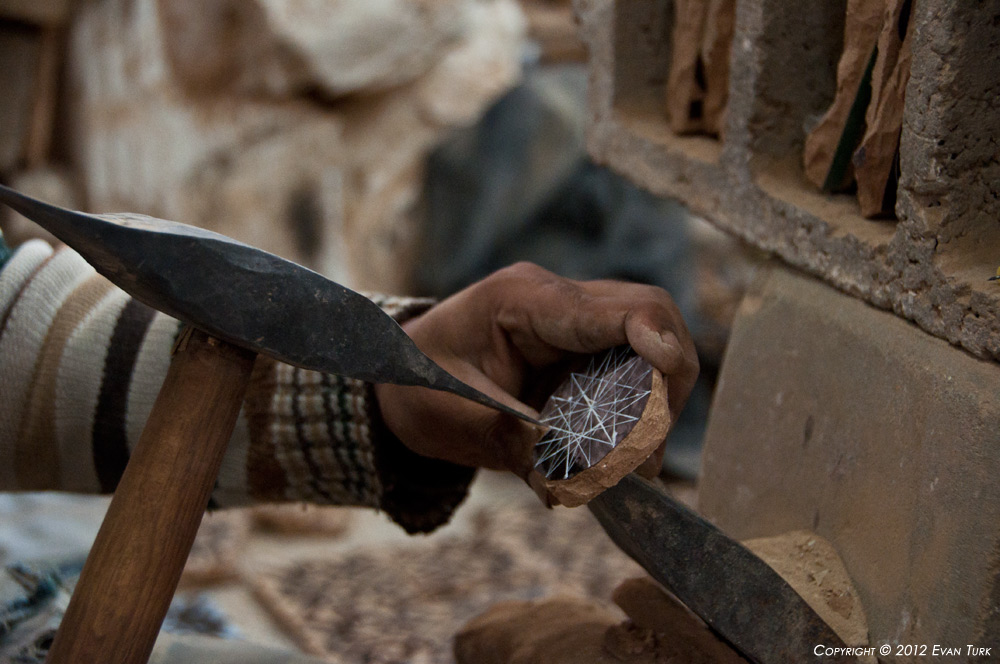
He then scored the iron and polished it with a jade-tipped utensil.


Then he heated the iron in a burner and it came out hot and jet black.


Then, using a tiny hammer, he hammered the silver wire into a design, like drawing.

 Once he finished, he polished it again with the jade, and gave it to us as a gift. It was so wonderful to see someone so passionate about what he was doing. His father had done Damasquine in gold, and he was the 5th generation of Damasquine workers in his family. He is the only one to practice the craft in Fes (although a dozen or so others do in the nearby city of Meknes), and he said that while his children enjoy drawing, they didn't like the hard manual labor that goes with creating the iron work, so he may be the last.

Sunday, February 3, 2013

Morocco: The Blue City


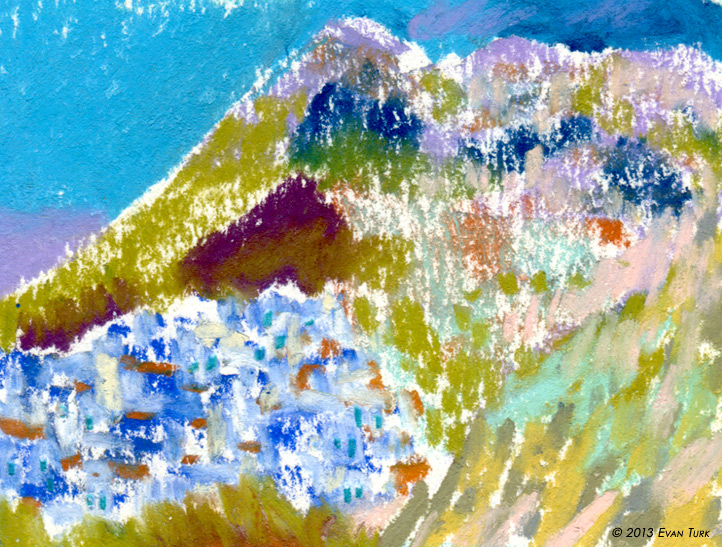
We took a short trip from Fez, through the Rif mountains to the beautiful blue city of Chefchaouen. The small town lies perched on a hillside in a valley surrounded by soaring, jagged peaks.


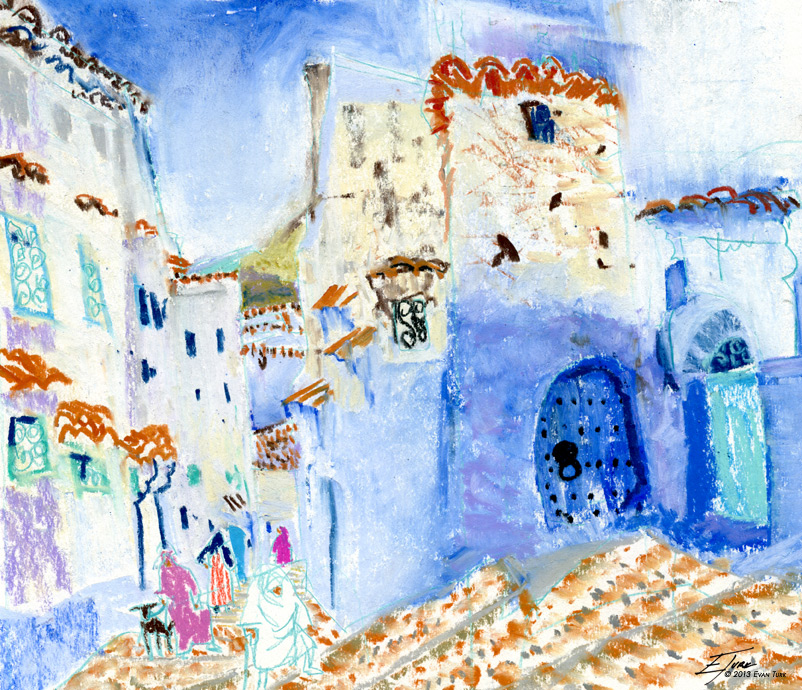
Since the 1930's, the walls of Chefchaouen's medina have been washed with blue pigment (possibly as a result of Jewish immigrants fleeing Europe). Thick layers of every color of blue imaginable coat the walls and streets of the city.


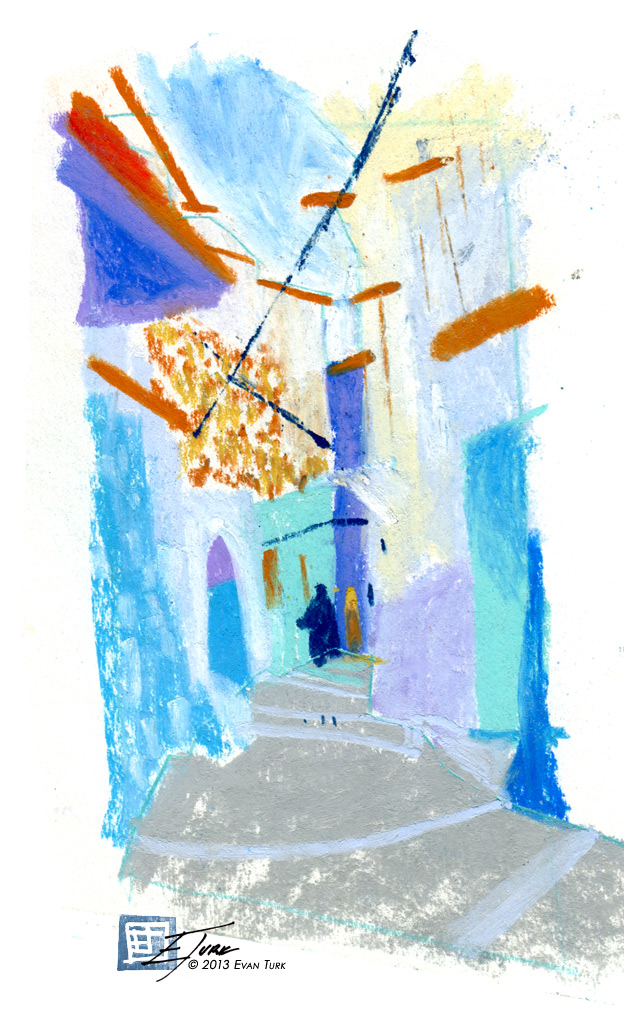
Because of the sheer cliffs of the Riff mountains, the city is connected by a web of incredibly steep stone staircases, which surprise you with bizarre, twisting, otherworldly views.


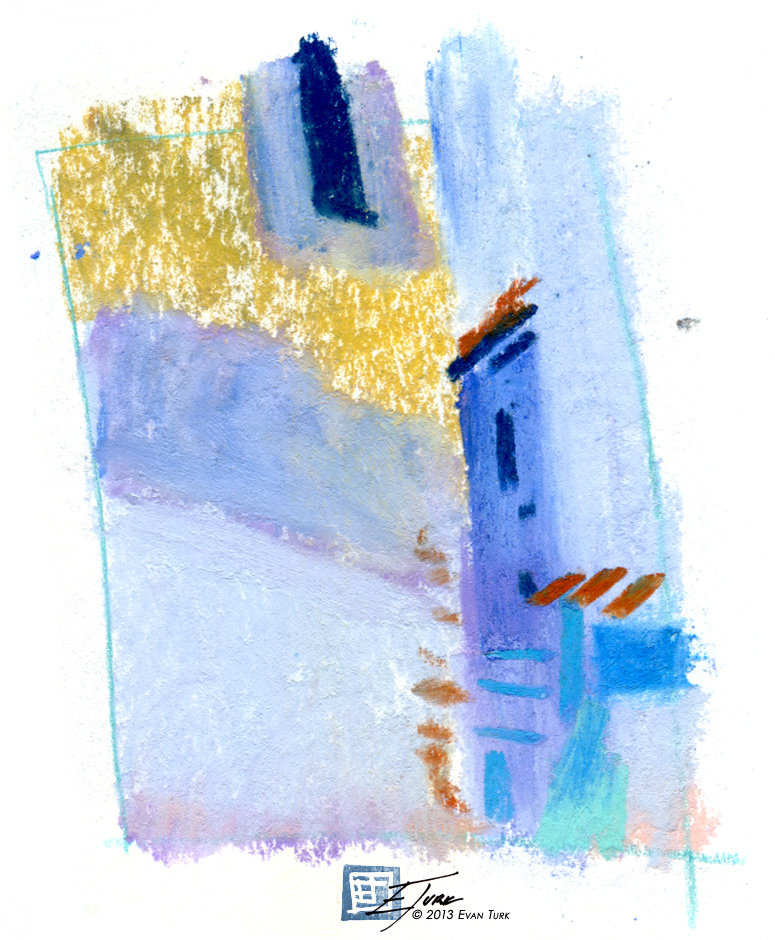
Some streets have so many colors at once that they feel like an abstract mosaic instead of a real city.


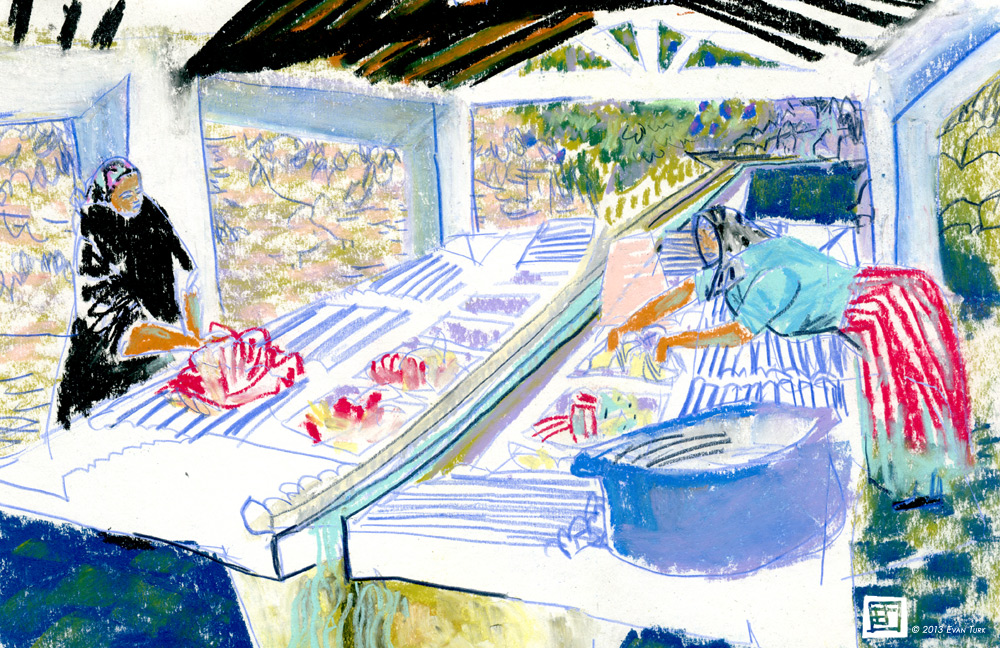
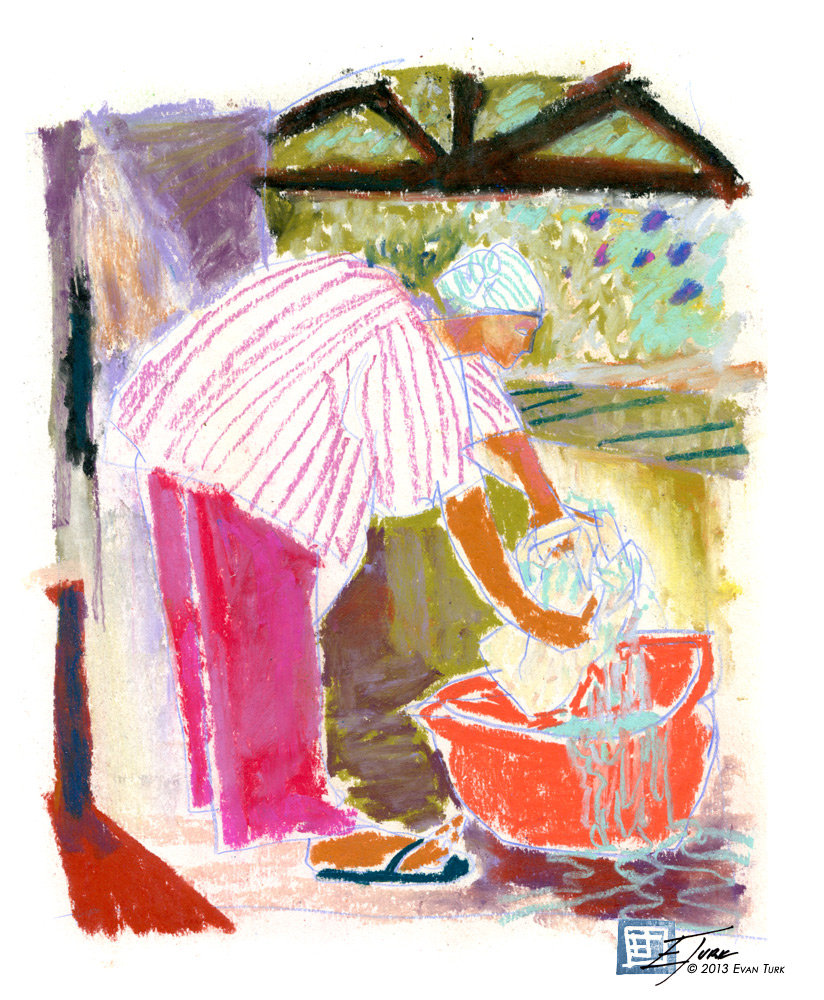
 Down one long staircase at the edge of the city, you find the Ras el-Maa river trickling down the stone steps into the valley. Here the women do their laundry on huge concrete beds in the river, in some of the most beautiful surroundings you can imagine. I couldn't help but want to draw, even though I felt a little intrusive drawing people just doing their laundry. My broken French was enough to get us through most of Morocco, but here on the eastern coast, they only speak Spanish and Arabic. Not knowing a word of Spanish, I mimed my way into asking whether or not it was okay for me to draw them.


Initially they seemed wary, so I contented myself with just drawing the scenery and leaving the women out. The old woman of the group came over and sat next to me while I drew for a while, and smiled as I struggled to ask her questions. Eventually, I successfully gestured my question, and she consented to let me draw them. They went on with their business, laughing and singing together over the sound of the trickling stream and the soft breeze rustling through the hillsides of morning glories.


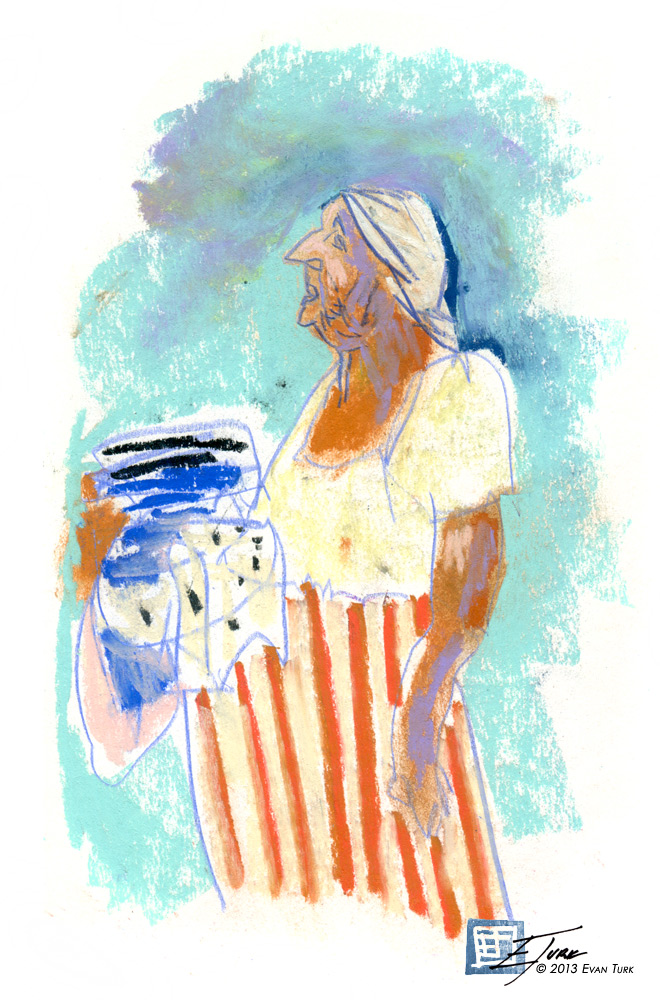
As I was drawing the teenage girl above, she seemed bashful because she was in her laundry clothes, and the old woman laughed and started asking me something in Spanish. I couldn't understand a word she was saying, or why the girl suddenly started blushing and laughing until I heard the word "matrimonio" pop out. Once I realized she was asking me, jokingly, if I was planning to marry her after such a tender drawing, I blushed and instinctively blurted out "No!". We all burst out laughing, and my cheeks turned more and more red as I frantically tried to make a more diplomatic decline of the offer (I don't think she took it personally).

The view out of our room at Casa La Palma


Our wonderful hosts, Ana and Carlos, at the beautiful bed and breakfast Casa La Palma were originally from Spain (only a couple hours away), and fell in love with Chefchaouen and moved there. With the incredible beauty, the calm, soothing air, and slow, trickling way of life, it's definitely a difficult city to leave.

Monday, January 21, 2013

Obama Inauguration 2013: Potential


"I have always believed that hope is that stubborn thing inside us that insists, despite all the evidence to the contrary, that something better awaits us so long as we have the courage to keep reaching, to keep working, to keep fighting."

 -President Barack Obama
in his acceptance of the Presidency, 2012


Last week, during a class with Dalvero Academy in Washington DC, we were fortunate enough to witness the rehearsal for President Obama's second inauguration. The capitol disappeared behind a sheet of fog as patriotic music beamed over thousands of empty chairs, waiting for an audience.


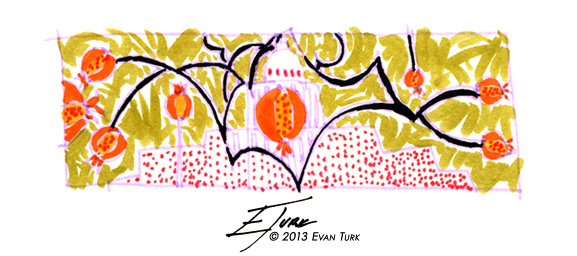
I listened from the nearby Bartholdi Garden under the branches of a pomegranate tree, thinking about the idea of potential. Inside this little fruit are dozens of seeds, bursting with potential. Each one could grow into a tree and bear it's own fruit. Today those thousands of chairs were full of people, each full of their own seeds of hope and the potential for unlimited possibilities.


With each new inauguration, there is more than just a change (or continuation) of leadership. There is the birth of thousands of new ideas and possibilities. People can hope for change whether it's now or in 4 years when another president will bring the potential for change.


So here's to 4 more years of hope, change and possibilities!

Saturday, January 19, 2013

Morocco: The Tanneries


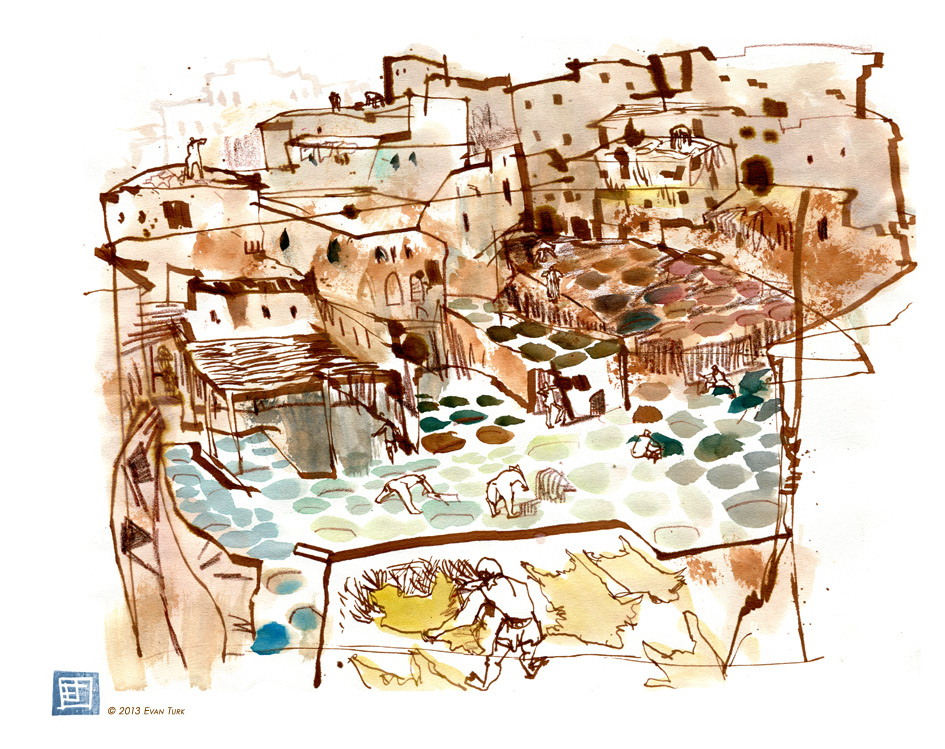
In Fes, one of the main attractions are the leather tanneries. Here, in the oldest leather tannery in the world, they produce leather using the same methods that were used nine centuries ago. After climbing the stairs, we emerged on a balcony overlooking sprawling rooftops perforated with giant vats of foul-smelling mixtures and vegetable dyes. The tour guides often give their groups sprigs of mint to hold in front of their noses to combat the smell (caused in part by large vats of acidic pigeon excrement and the raw hides themselves). Men worked in and in between the vats, scraping, cleaning, dying, and drying the mountains of animal hides.


Friday, January 4, 2013

Happy New Year!


Happy New Year! I'm a few days late, but I found this drawing and it felt like a good first post of the New Year. Pine trees are symbolic of strength in adversity, fertility, creativity, regeneration, and good luck. All good hopes for 2013!

I drew this at Kissena Park in Queens during the nice warm summer, and now that the holiday season is over, the weather is officially allowed to skip straight ahead to spring.

Friday, December 28, 2012

Morocco: Tile Workshop


While in the city of Fes, we had the wonderful opportunity to tour and draw at the Moroccan architectural decoration workshop of Arabesque (Moresque). While at the Metropolitan Museum of Art in New York, I noticed the brand name in the videos of the construction of the new, very beautiful Moroccan court in their Islamic Art wing. I contacted Arabesque, the creators of the court, and they welcomed us to come and draw in their workshop for a day.


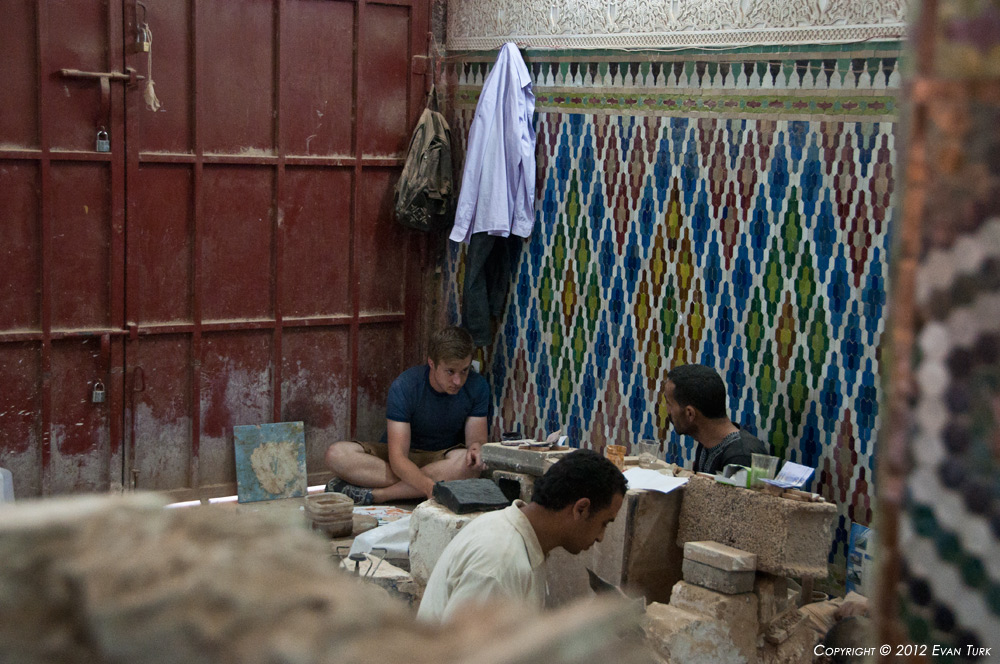
The factory was in the Ville Nouvelle, the modern city outside the medieval medina. It was a sprawling three floor establishment, with the dozen or so zellij tile workers huddled together in one small dusty corner on the first floor.


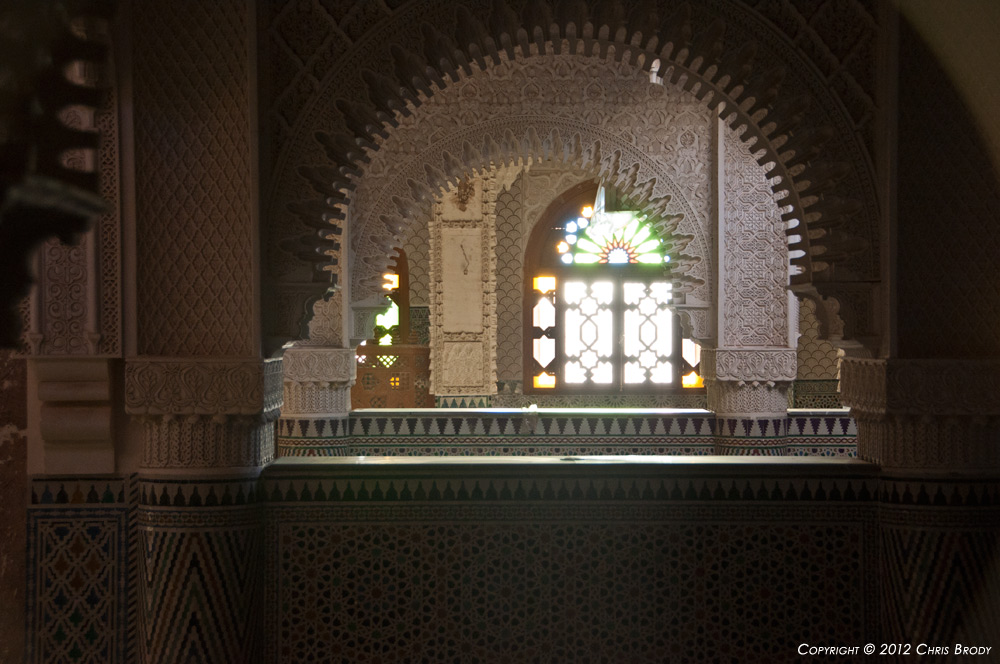
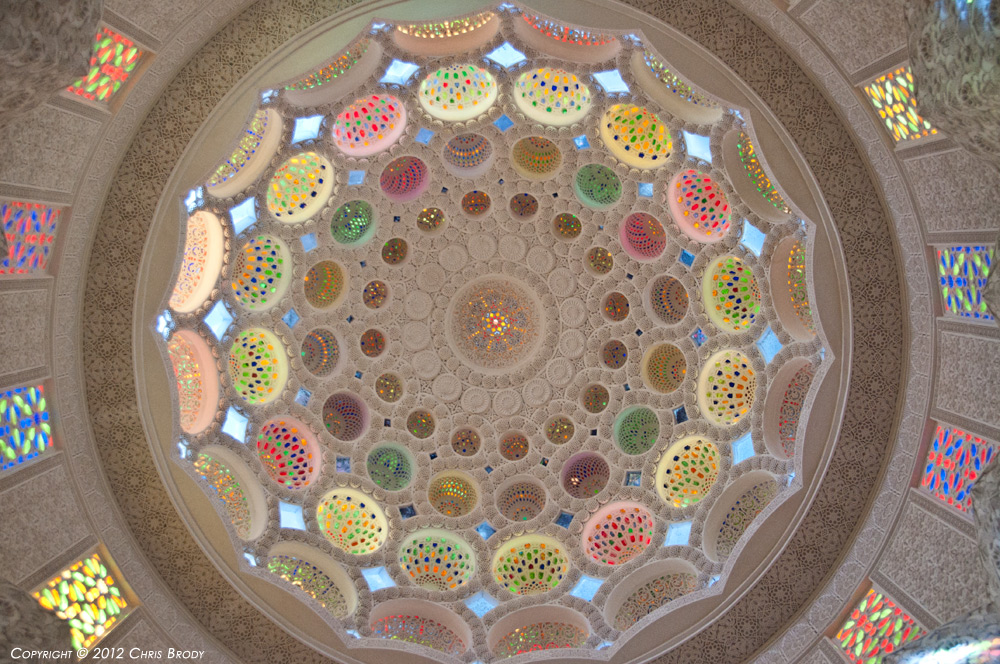
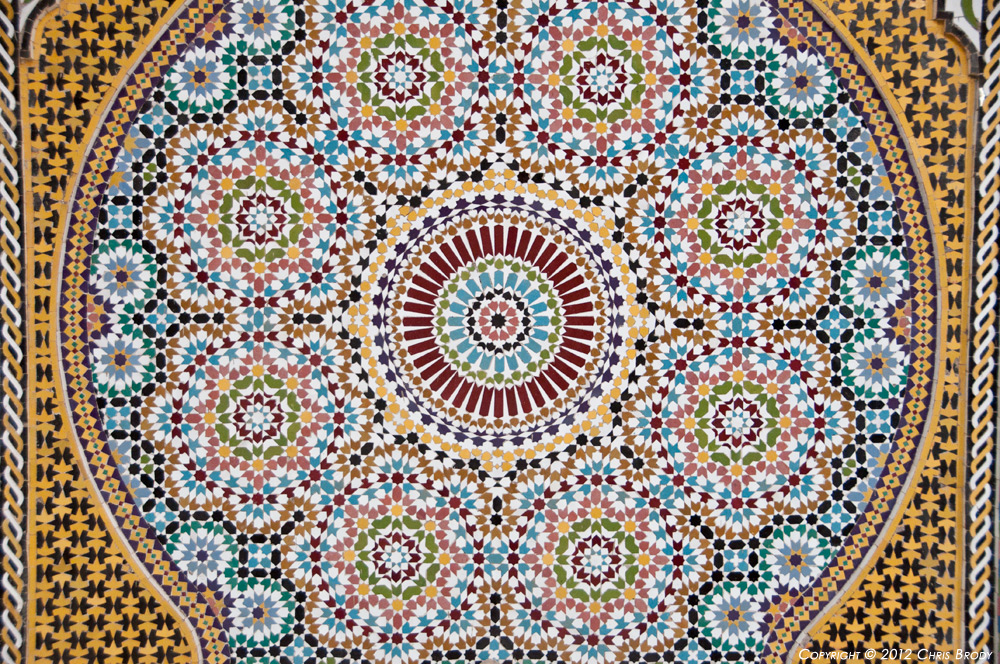
 The other floors housed incredible in-progress display rooms that were created using modern designs and techniques as well as replicating each individual period of Islamic decoration with perfect attention to detail. The colors, glazes, patterns, and shapes were created using the original period-specific methods. The detail, precision, and beauty were incredible to see. All of the carved plaster, stained glass, intricately painted wood, and zellij tile were all created by the master craftsmen there.


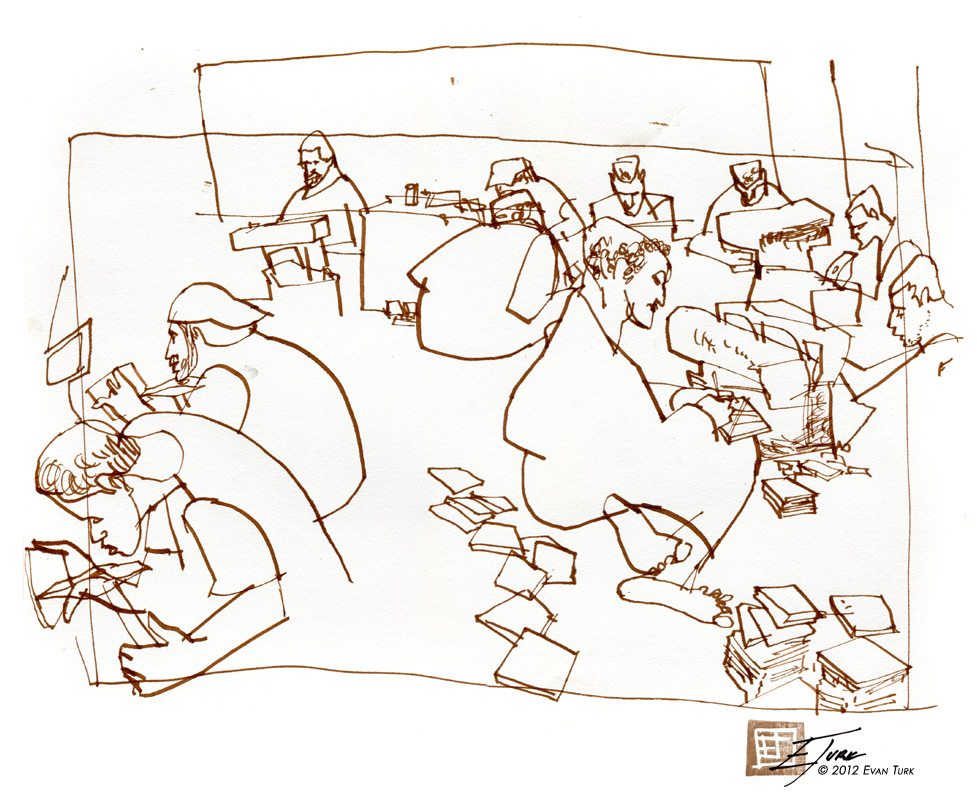
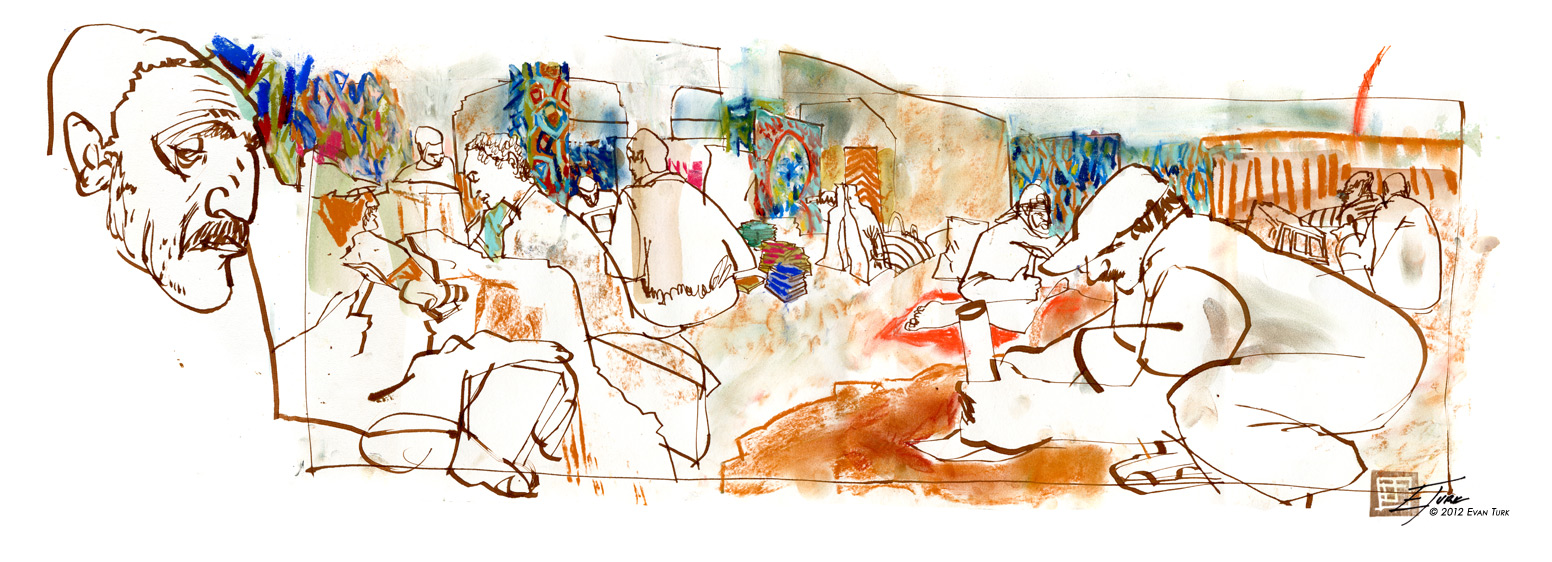
I spent most of my day watching the workers on the first floor, listening to the repetitive tinkling of the chisels on tile. The incredible amount of work involved in creating just one tiny tile is awe-inspiring when you consider the scope of an entire wall. Each shape must be traced out onto the tile in a white paste, and then every extra piece chiseled away to perfection. The glazed ceramic tiles are held against a cinder-block and tapped precisely and delicately with a surprisingly hefty chisel until it has been chipped into the specific shape to fit into the overall design.


Each man had a specific task. One would draw the design onto a tile; some would chisel the raw tiles into large squares;


 some chiseled the squares into smaller pieces; 


 some chiseled them into even more intricate pieces;


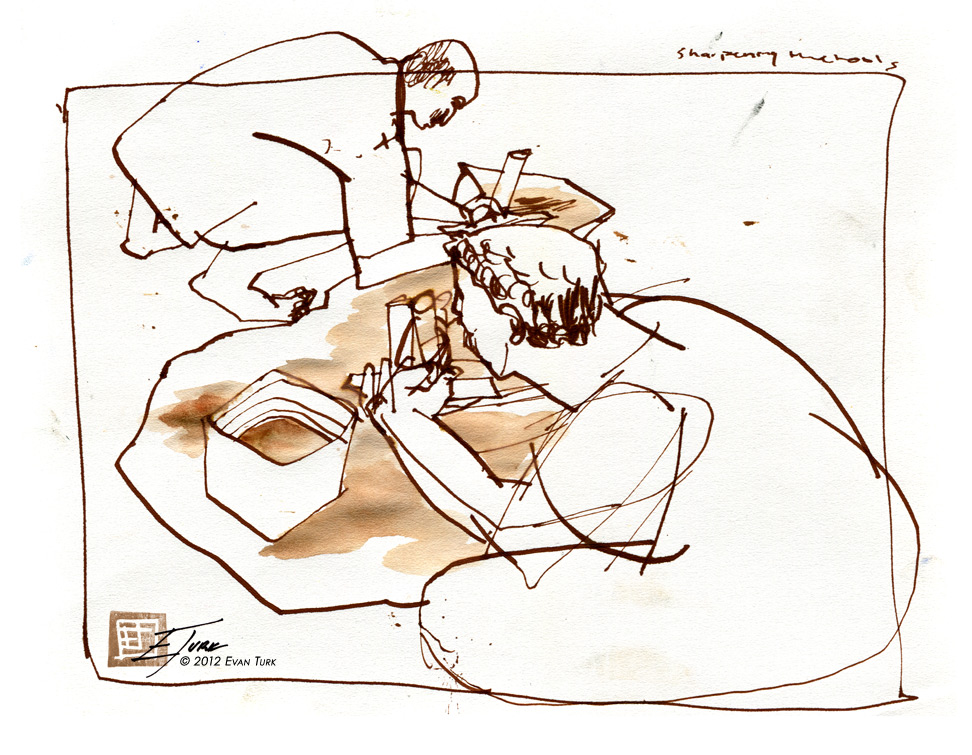
some stopped to sharpen their chisels;


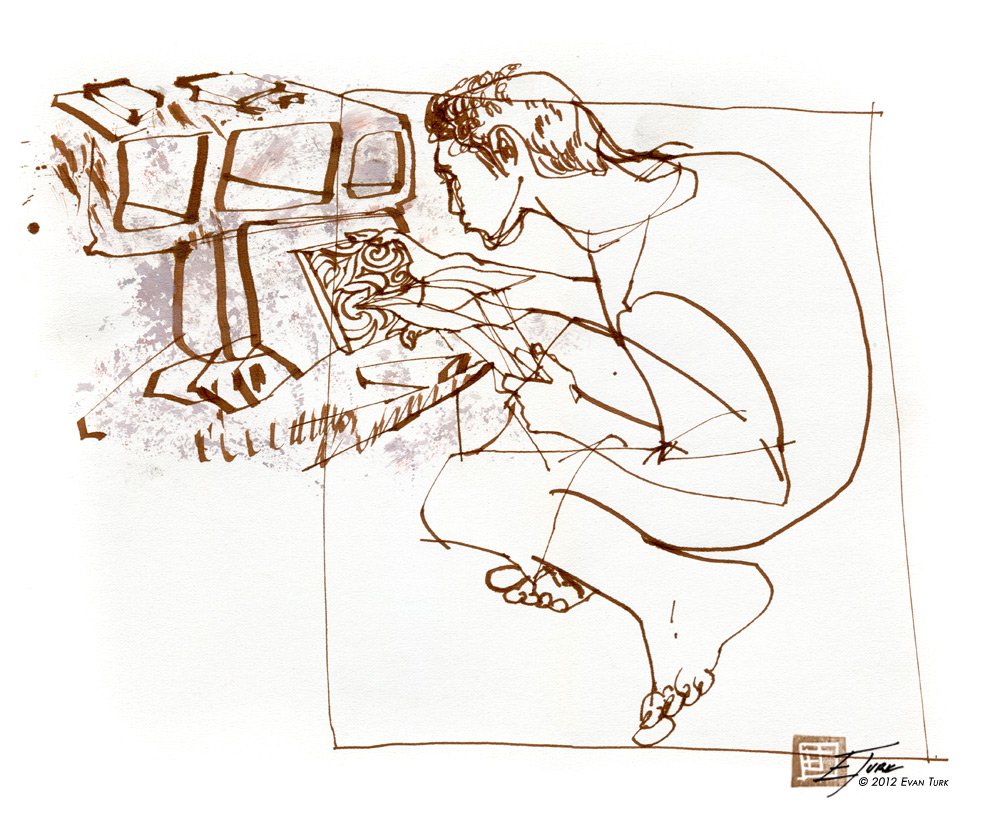
some stenciled designs on tiles and chiseled away scrolling pieces of a larger pattern;


and all together they worked like pieces of a machine to create beautiful, mind-boggling work.
  

It was a wonderful experience to be able to spend the day there, and to see the whole process. Many thanks to Adil M. Naji, the President and CEO of Moresque/Arabesque, for agreeing to have us come and for his wonderful hospitality, and to all of the craftsmen for their warmth, kindness and willingness to let me impose on their work.


Tuesday, December 18, 2012

Morocco: Children


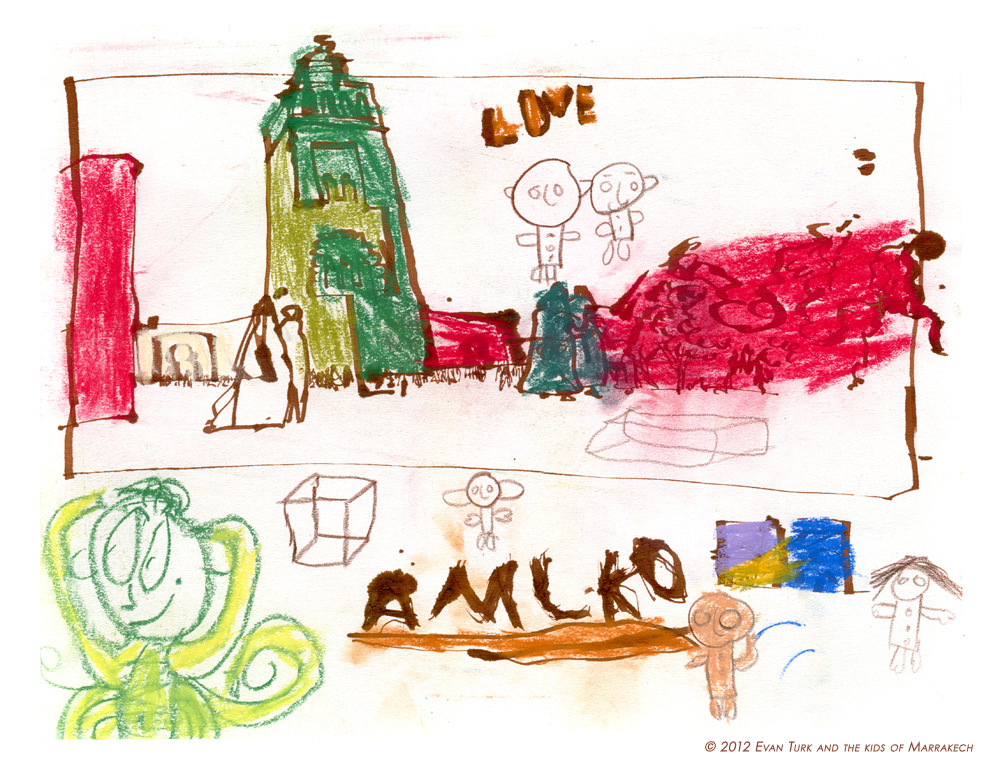
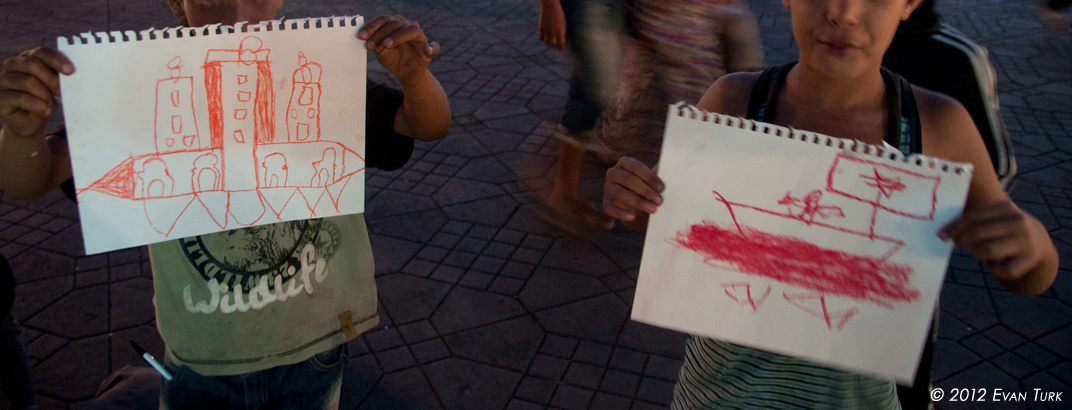
While we were in Marrakech there were a few times when kids would come by and watch us draw. One little boy found us near the Koutoubia, and helped make the drawing above. He even drew our portraits! I'm the monkey, and Chris is the one next to the cube with the big ears.

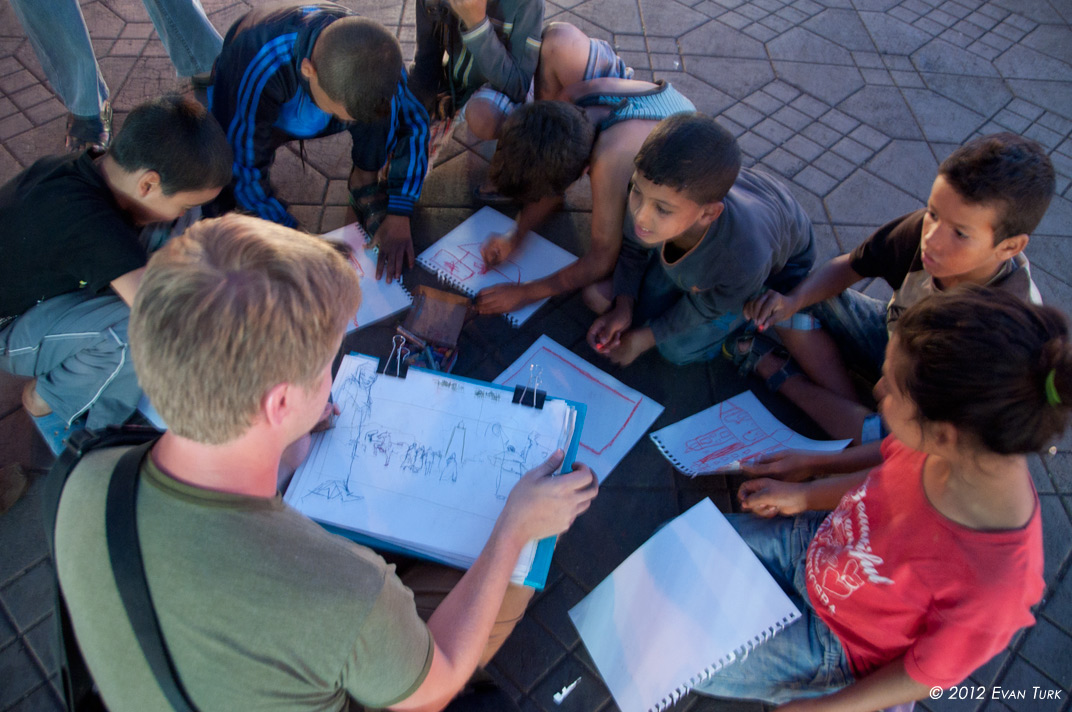
The next week, after coming back from Essaouira, we saw him again and he sat down to draw with me. Chris gave him a sheet of paper, and soon more and more kids crowded around. Chris gave them each a sheet of paper, and they were so excited to draw and play around with my pastels.

Last week, Dalvero Academy had an open house, and many of the artists brought their kids to draw as well. Looking around, it was amazing to see how much their drawings looked like the Moroccan kids' drawings. The same set up, but minus the minaret or a Moroccan flag in the background. It is the same joy, love, and play that kids have no matter where they are born.

My thoughts are with those children and parents in Newtown, Connecticut this week. I grew up in the neighborhood where the Columbine tragedy happened in 1999, and I can still only imagine what the community there is going through. My hope is that the children from that school who survived will still find the same joy, love, and play, and will find a way to heal and still be kids.